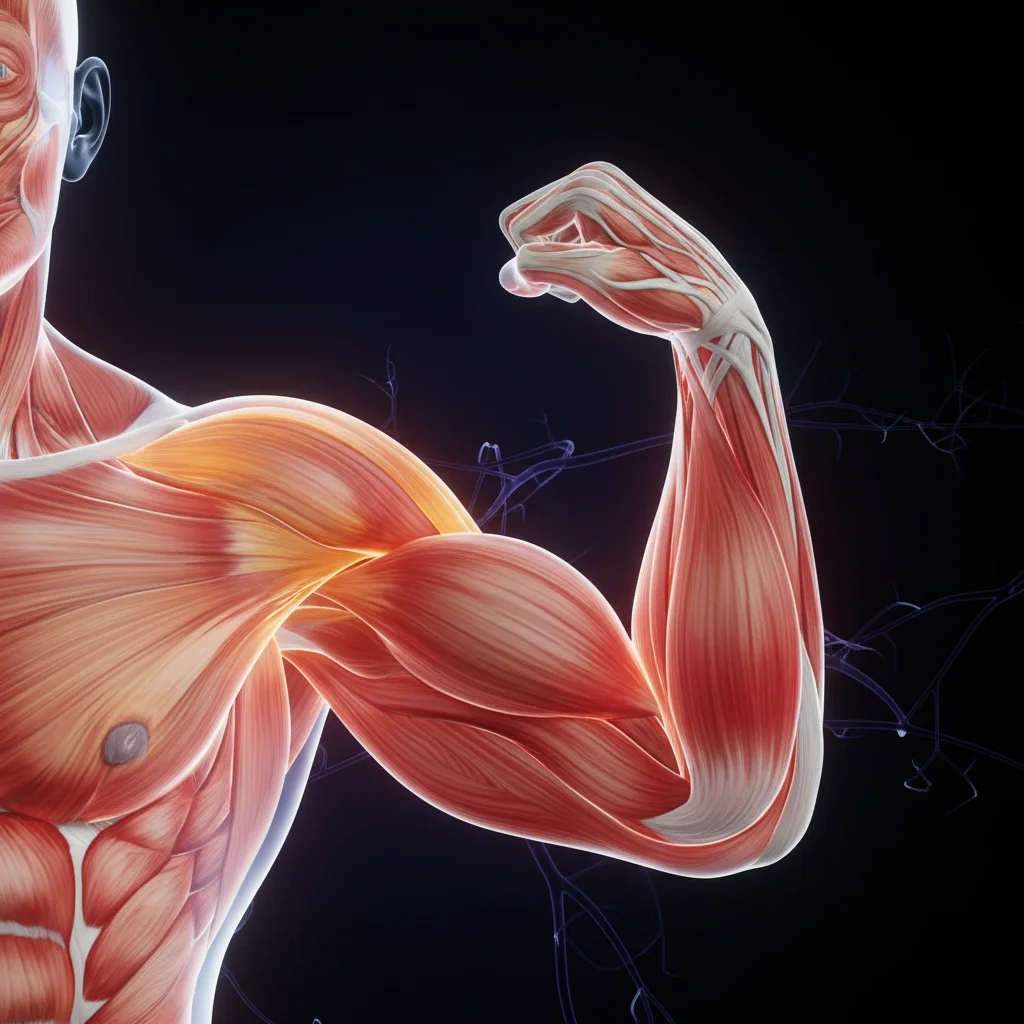
It seems like a simple question: where are your biceps? But understanding the exact location—and what's around them—helps you train smarter and recognize when something's wrong.
Basic Location
Your biceps are located on the front of your upper arm, between your shoulder and elbow. When you flex your arm and see that "ball" of muscle—that's your biceps.
Specifically, the biceps brachii runs from your shoulder blade (scapula) to your forearm bone (radius), crossing both the shoulder and elbow joints.
Pro Tip
Feel your bicep by placing your opposite hand on the front of your upper arm and then flexing. The hard lump that rises up is your biceps muscle contracting.
The Two Heads
Your biceps has two distinct heads:
Long Head:
• Located on the outer (lateral) part of your arm
• Creates the "peak" when you flex
• Starts at the top of your shoulder socket (supraglenoid tubercle)
• Visible from the side when well developed
Short Head:
• Located on the inner (medial) part of your arm
• Creates width when viewed from the front
• Starts at a bump on your shoulder blade (coracoid process)
• Gives your arm that "full" look
Both heads merge together before attaching to the radius bone at your elbow.
Surrounding Anatomy
Above (toward shoulder):
• Anterior deltoid (front shoulder)
• Bicep tendons that attach to the shoulder blade
Below (toward elbow):
• Distal bicep tendon
• Brachioradialis (forearm muscle)
• Elbow joint
Behind:
• Humerus (upper arm bone)
• Brachialis (deep elbow flexor)
In front:
• Skin and subcutaneous fat
• Just below the skin surface
Opposite side:
• Triceps brachii (back of upper arm)
Attachment Points
Origin (where the muscle starts):
• Long head: Supraglenoid tubercle of scapula
• Short head: Coracoid process of scapula
Insertion (where the muscle ends):
• Both heads merge into a single tendon that attaches to the radial tuberosity (a bump on the radius bone near your elbow)
The fact that the biceps crosses two joints (shoulder and elbow) is why arm position affects which head works harder.
Feeling Your Biceps
At rest: With arm relaxed, the biceps is soft and difficult to distinguish from surrounding tissue.
During contraction: Flex your arm (bring hand toward shoulder). The biceps becomes hard and prominent.
Location check: The main muscle belly is in the middle of your upper arm's front surface. The long head is toward the outside, short head toward the inside.
Common Confusion
"Bicep" pain at the shoulder: Often actually the bicep tendon or rotator cuff. The bicep muscle itself doesn't reach the shoulder joint—but its tendon does.
"Bicep" pain at the elbow: Could be the distal bicep tendon, brachialis, or brachioradialis. These structures are close together at the elbow.
The brachialis: This muscle lies UNDER the biceps. You can't see it directly, but when developed, it pushes the biceps up and makes the arm look bigger.
Why Location Matters for Training
Knowing exactly where your biceps are helps you:
• Feel the muscle working during curls (mind-muscle connection)
• Identify which head is being emphasized
• Recognize when other muscles are compensating
• Understand pain and injury locations
Put your hand on your bicep during your next set. Feel where it contracts hardest. That awareness makes your training more effective.