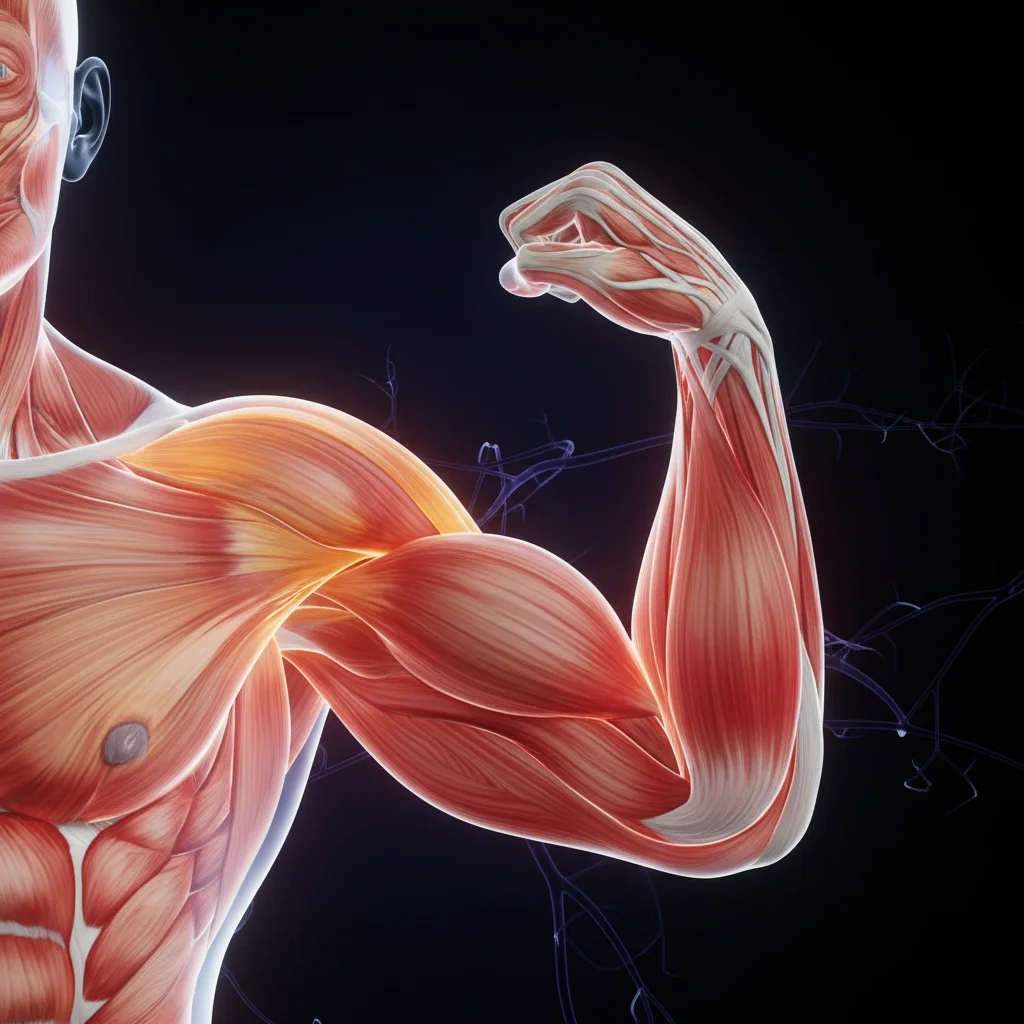
If you want to build bigger biceps, you need to understand what you're actually working with. The biceps isn't just one muscle—it's a complex of muscles working together. And the way you train them should reflect that complexity.
Let me take you through the anatomy of your upper arm so you can train smarter.
The Biceps Brachii
When people say "biceps," they usually mean the biceps brachii—the large two-headed muscle on the front of your upper arm. "Bi" means two, "ceps" refers to heads.
Long Head:
The outer portion of your biceps. It originates at the supraglenoid tubercle of the scapula (shoulder blade) and runs along the outside of your arm.
The long head is what creates the "peak" when you flex. It's emphasized when your arms are behind your body (like during incline curls) because that position stretches it.
Short Head:
The inner portion. It originates at the coracoid process of the scapula and runs along the inside of your arm.
The short head adds width to your biceps when viewed from the front. It's emphasized when your arms are in front of your body (like during preacher curls).
Both heads merge into a single tendon that attaches to the radius bone at your elbow (the radial tuberosity).
Pro Tip
You can't fully isolate one head from the other, but you can shift emphasis based on arm position. Arms behind you = more long head. Arms in front = more short head.
Functions of the Biceps
The biceps has three main functions:
1. Elbow Flexion:
Bending your arm at the elbow—bringing your hand toward your shoulder. This is what happens during every curl variation.
2. Forearm Supination:
Rotating your forearm so your palm faces up. This is often overlooked but very important. The biceps is a powerful supinator, which is why rotating your pinky outward at the top of a curl increases contraction.
3. Shoulder Flexion (minor):
Raising your arm in front of you. The biceps assists in this movement, though it's not the primary mover.
The Brachialis
The brachialis is the unsung hero of arm development. It sits underneath the biceps brachii and contributes significantly to arm size.
Location: Deep to the biceps, on the front of the humerus
Function: Pure elbow flexion. Unlike the biceps, it doesn't cross the shoulder joint and doesn't supinate the forearm.
Why it matters: A well-developed brachialis pushes your biceps up and out, making your arm appear larger from the side. It's responsible for much of the "thickness" you see in impressive arms.
How to train it: Neutral grip exercises (hammer curls, cross-body curls) and pronated grip exercises (reverse curls) emphasize the brachialis because they reduce biceps involvement.
The Brachioradialis
Technically a forearm muscle, the brachioradialis contributes to arm aesthetics and function.
Location: Top of the forearm, near the elbow. It's the "meaty" part you see when you make a fist.
Function: Elbow flexion, especially when the forearm is in a neutral or pronated position.
How to train it: Hammer curls and reverse curls emphasize this muscle. It's also heavily involved in rows and pulling movements.
How Muscle Shape Is Determined
An important truth: muscle shape is largely genetic. The insertion points, the peak potential, and the overall appearance of your biceps are determined by your DNA.
What you CAN control:
• Muscle size (through training and nutrition)
• Body fat levels (which affect visibility)
• Symmetry between arms
• Complete development of all heads and surrounding muscles
What you CANNOT change:
• Where your muscle inserts on the bone
• Basic muscle shape
• Peak height potential
Train to maximize your genetic potential, not to match someone else's anatomy.
Applying Anatomy to Training
For overall bicep development:
Standard curls with full supination—barbell curls, dumbbell curls, EZ bar curls
For long head (peak) emphasis:
Exercises with arms behind the body—incline curls, drag curls, behind-back cable curls
For short head (width) emphasis:
Exercises with arms in front—preacher curls, spider curls, high cable curls
For brachialis development:
Neutral grip exercises—hammer curls, cross-body curls
For brachioradialis development:
Pronated grip exercises—reverse curls, reverse preacher curls
Complete Arm Development
To build impressive arms, you need to train all these components:
• Biceps brachii (both heads)
• Brachialis
• Brachioradialis
• Triceps (which make up 2/3 of your upper arm)
A well-rounded program includes exercise variety to hit every muscle from multiple angles. Understanding anatomy helps you make smarter exercise choices.