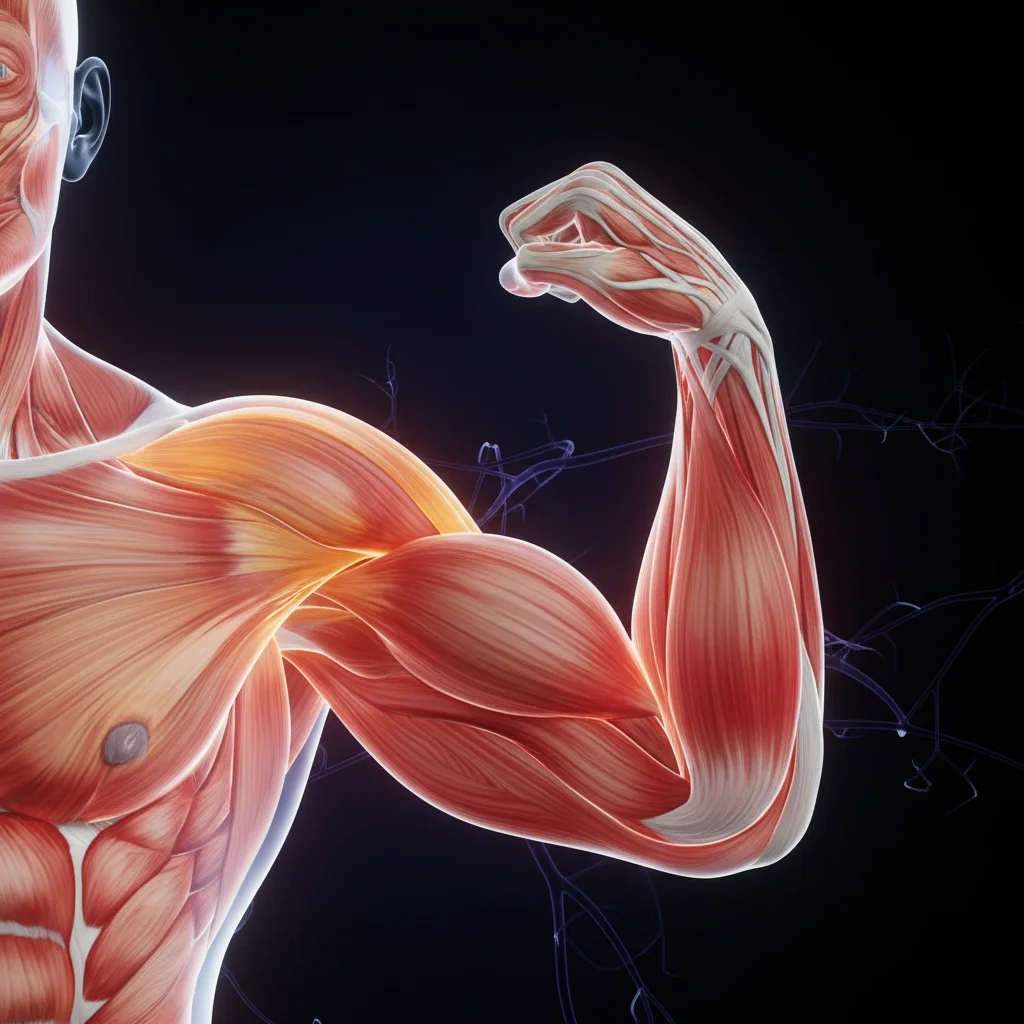
The bicep curl looks simple: you pick up a weight and bend your elbow. But there's actually a lot happening anatomically during this basic movement. Understanding the mechanics helps you optimize your form and maximize muscle activation.
Muscles Involved in the Bicep Curl
Primary Movers (Agonists):
• Biceps brachii (long head and short head)
• Brachialis
• Brachioradialis
These muscles actively contract to flex your elbow and lift the weight.
Stabilizers:
• Anterior deltoid (front shoulder)
• Wrist flexors
• Core muscles
These muscles hold positions steady but don't create the primary movement.
Antagonist:
• Triceps brachii
The triceps must relax and lengthen to allow elbow flexion.
Pro Tip
Think about "pulling" with your biceps rather than "lifting" the weight. This mental cue shifts focus from the weight to the muscle, improving mind-muscle connection.
Phase-by-Phase Analysis
Starting Position (Arms Extended):
• Biceps are lengthened (stretched)
• Brachialis is lengthened
• Elbow angle approximately 175-180 degrees (slight bend to protect joint)
• This is the position of maximum muscle length and minimum contraction
Concentric Phase (Lifting):
• Biceps and brachialis contract, pulling forearm toward upper arm
• If using supinated grip, biceps is maximally active
• Muscle tension increases as leverage decreases
• Hardest point (for standard curls) is mid-range, around 90 degrees
Peak Contraction (Top Position):
• Biceps is fully shortened
• Elbow angle approximately 30-45 degrees
• Maximum muscle squeeze possible here
• This is where you should pause and contract hard
Eccentric Phase (Lowering):
• Biceps lengthens under tension (eccentric contraction)
• This phase causes more muscle damage than lifting
• Should be controlled (2-3 seconds)
• Biceps acts as a brake against gravity
The Strength Curve
The bicep curl has an interesting strength curve:
Bottom position: Mechanically easiest. The weight is close to the elbow joint (short lever arm). But the muscle is stretched, so it can generate good force.
Mid-range (90 degrees): Mechanically hardest. The lever arm is longest here—the weight is farthest from the joint. This is where most people fail.
Top position: Mechanically easier again. The lever arm shortens as the forearm approaches vertical. But the muscle is maximally shortened, so force production decreases.
This is why the middle portion of a curl feels hardest—it's physics, not weakness.
Grip Variations and Muscle Activation
Supinated Grip (palms up):
Maximum biceps activation. The biceps is a supinator, so a fully supinated grip puts it in its strongest position.
Neutral Grip (palms facing each other):
Reduced biceps activation, increased brachialis and brachioradialis involvement. Good for overall arm thickness.
Pronated Grip (palms down):
Minimal biceps involvement. Emphasizes brachioradialis and forearm extensors.
Common Form Errors and Their Effects
Elbow drift forward:
Reduces bicep tension by shortening the lever arm. Also recruits the anterior deltoid. Keep elbows pinned at sides.
Swinging/momentum:
Reduces time under tension and muscle activation. Uses body momentum instead of bicep strength. Control the weight.
Partial range of motion:
Skipping the stretched (bottom) or contracted (top) positions reduces total muscle fiber recruitment. Full range builds more muscle.
Wrist flexion:
Curling the wrists at the top takes tension off biceps and puts it on forearm flexors. Keep wrists neutral.
Optimizing the Curl
Based on the anatomy and mechanics:
For maximum biceps activation:
• Use a supinated grip
• Keep elbows stationary at your sides
• Full range of motion
• Squeeze hard at the top
• Slow, controlled eccentric
For brachialis emphasis:
• Use a neutral grip (hammer curls)
• Same form principles apply
For forearm emphasis:
• Use a pronated grip (reverse curls)
• Slightly lighter weight to maintain form
Putting It Together
The bicep curl is more than just "bend your elbow." Understanding which muscles work, when they work hardest, and how grip affects activation helps you train smarter.
Focus on form, control the weight through all phases, and squeeze at the top. That's how you turn a simple movement into an effective muscle builder.