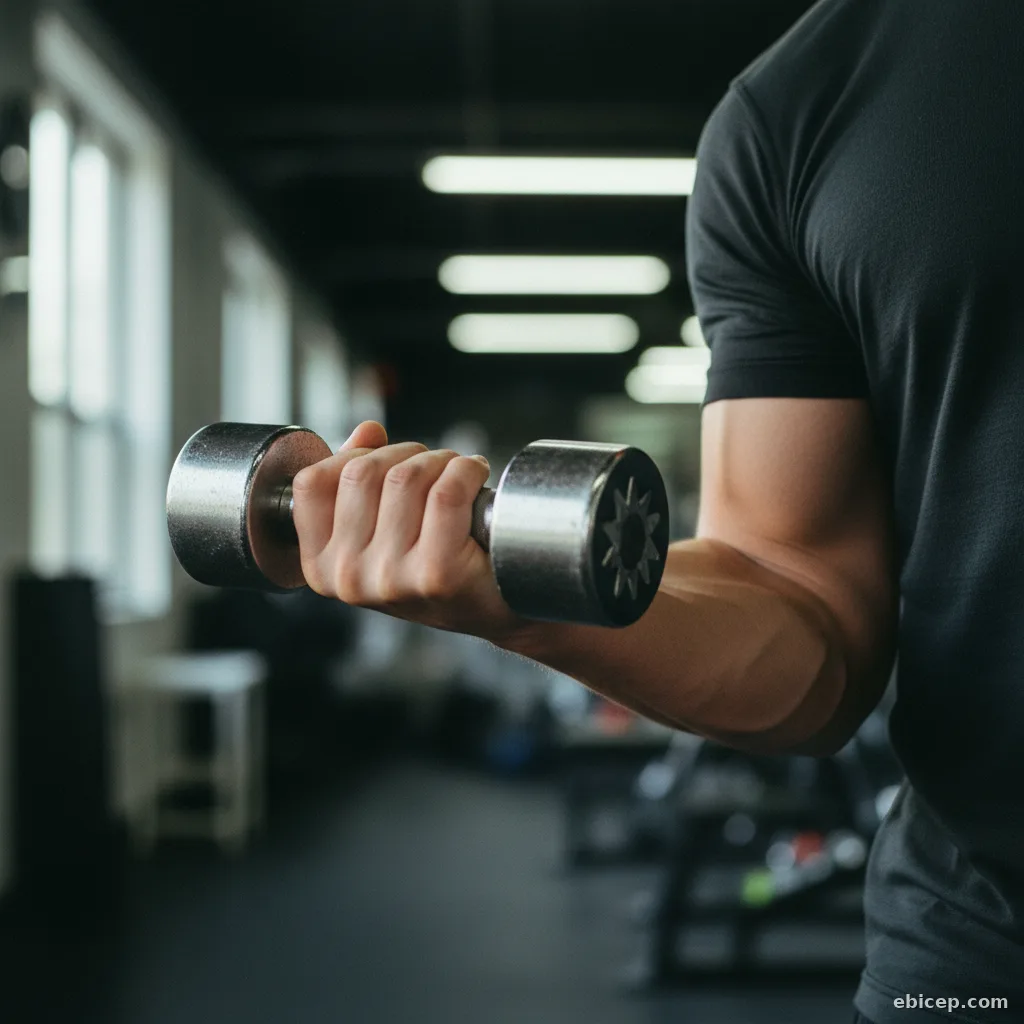
When you curl, more than just your biceps are working. Understanding which muscles activate during curls—and how—helps you get more from every rep.
Primary Movers (Agonists)
These muscles produce the curling motion:
Biceps Brachii
The most obvious one. Both heads (long and short) work together to flex your elbow and supinate your forearm. During a standard supinated curl, the biceps is the prime mover.
• Long head: Outer portion, creates the peak
• Short head: Inner portion, creates width
Brachialis
Lies underneath the biceps. A pure elbow flexor that works during every curl regardless of grip. With neutral or pronated grips, it becomes even more important as the biceps' contribution decreases.
Brachioradialis
A forearm muscle that assists with elbow flexion. Most active with neutral (hammer) or pronated (reverse) grips. Less active with supinated grips.
Pro Tip
Grip rotation changes which muscles work hardest: supinated (palms up) = biceps dominant, neutral (palms facing) = brachialis/brachioradialis dominant, pronated (palms down) = brachioradialis dominant.
Stabilizers
These muscles hold positions steady:
Anterior Deltoid
The front shoulder muscle stabilizes your upper arm during curls. It shouldn't be doing much work—if it is, you're probably swinging.
Wrist Flexors
The muscles on the underside of your forearm work to keep your wrist stable during supinated curls. If they're weak, your wrists will give out before your biceps.
Wrist Extensors
The muscles on top of your forearm stabilize during pronated (reverse) curls.
Core Muscles
Your abs and lower back stabilize your torso, preventing swaying. More important during standing curls than seated variations.
Upper Back
The rhomboids and middle trapezius keep your shoulder blades in position. They work harder during heavier curls.
Antagonist
Triceps Brachii
The muscle on the back of your arm must relax and lengthen to allow elbow flexion. If your triceps are overly tight, they can restrict your range of motion on curls.
How Grip Changes Muscle Emphasis
Supinated Grip (palms up):
• Biceps: High activation
• Brachialis: Moderate activation
• Brachioradialis: Low-moderate activation
Best for: Maximum bicep development
Neutral Grip (palms facing each other):
• Biceps: Moderate activation
• Brachialis: High activation
• Brachioradialis: High activation
Best for: Overall arm thickness
Pronated Grip (palms down):
• Biceps: Low activation
• Brachialis: Moderate-high activation
• Brachioradialis: Very high activation
Best for: Forearm development, grip strength
How Arm Position Changes Muscle Emphasis
Arms behind body (incline curls):
Long head of biceps is stretched and emphasized
Arms at sides (standing curls):
Both bicep heads work equally
Arms in front (preacher curls):
Short head of biceps is emphasized
Range of Motion and Muscle Activation
Bottom position (arms extended):
Muscles are stretched. Lower activation but important for muscle damage and stretch-mediated hypertrophy.
Mid-range (90-degree elbow bend):
Highest mechanical load. Most challenging position. Muscles working hardest against resistance.
Top position (fully contracted):
Muscles shortened. Peak contraction. Important for maximizing squeeze and mind-muscle connection.
Putting It All Together
For complete arm development, you need exercises that emphasize different muscles:
For biceps: Supinated curls (barbell, dumbbell, EZ bar)
For brachialis: Hammer curls, cross-body curls
For brachioradialis: Reverse curls, hammer curls
For forearm flexors: Wrist curls, grip work
A well-rounded program includes all of these, not just standard bicep curls.
Common Mistakes That Change Muscle Activation
Swinging: Shifts work from biceps to anterior deltoid and momentum.
Elbow drift: Moving elbows forward recruits shoulders, reducing bicep work.
Partial range: Missing the bottom or top reduces total muscle activation.
Wrist curl at top: Takes tension from biceps, puts it on forearm flexors.
Fix these, and you'll feel a massive difference in muscle activation.