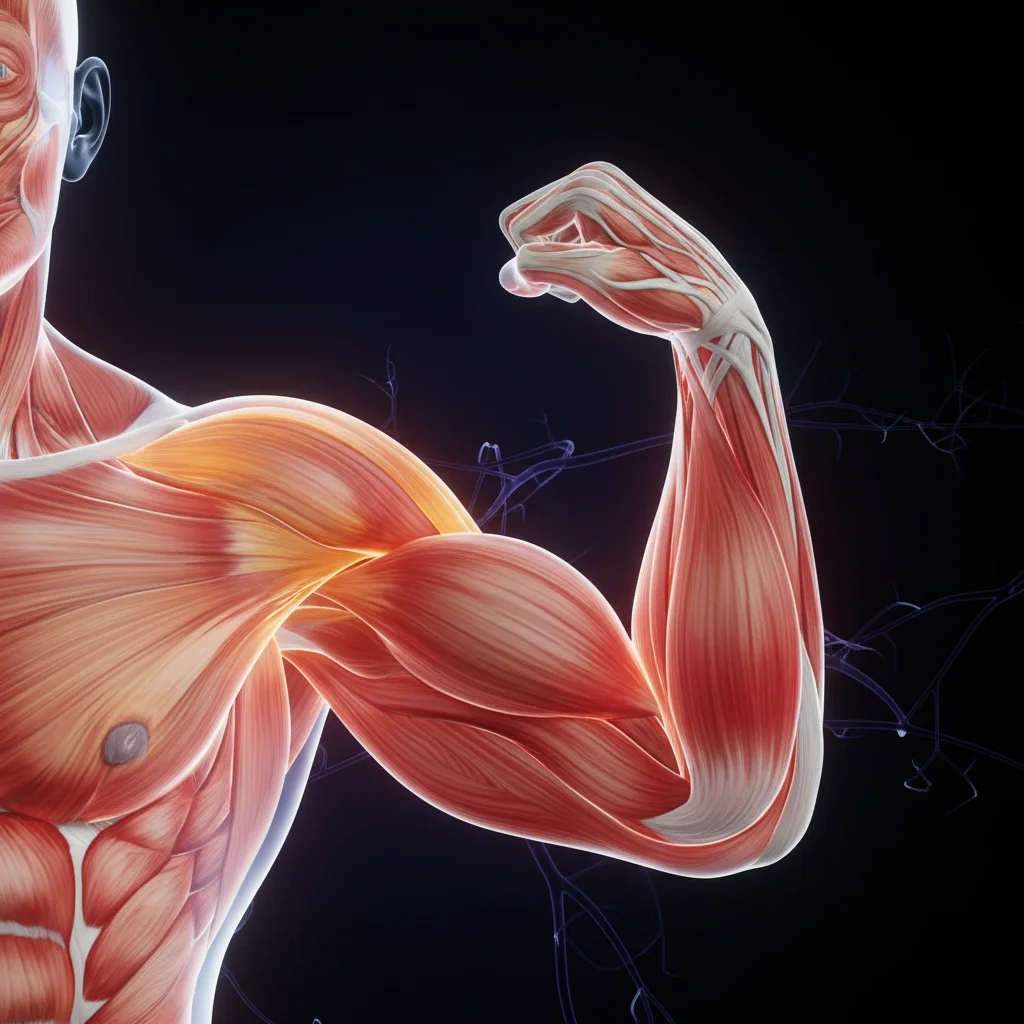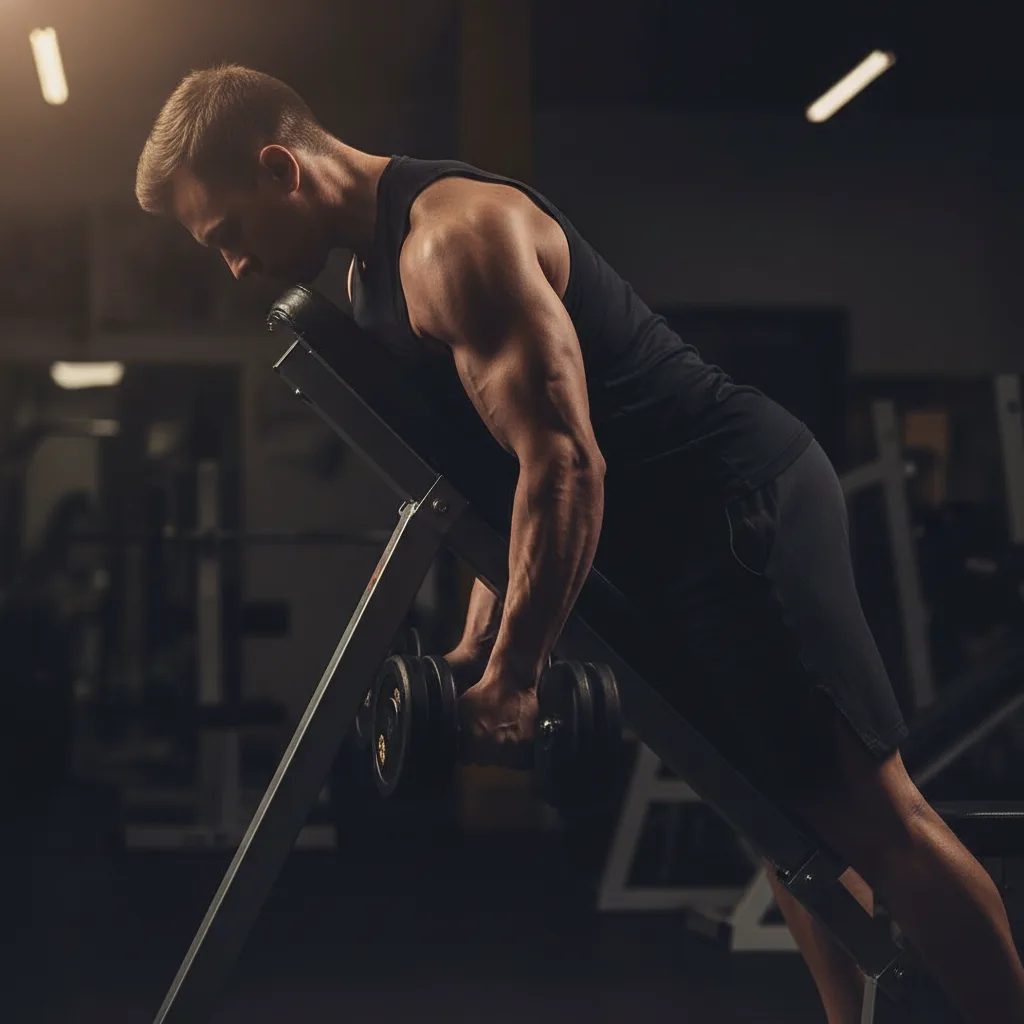
Your arm has over twenty individual muscles — and most lifters can name maybe three. Biceps, triceps, forearms. That's it. The rest are a blur of Latin words that got skipped in biology class.
Knowing your arm muscle anatomy matters more than you'd think. Understanding which muscles do what helps you pick better exercises, fix weak points, and figure out why certain movements feel off. You don't need a medical degree — just a clear map of what's under the skin and what each muscle actually does.
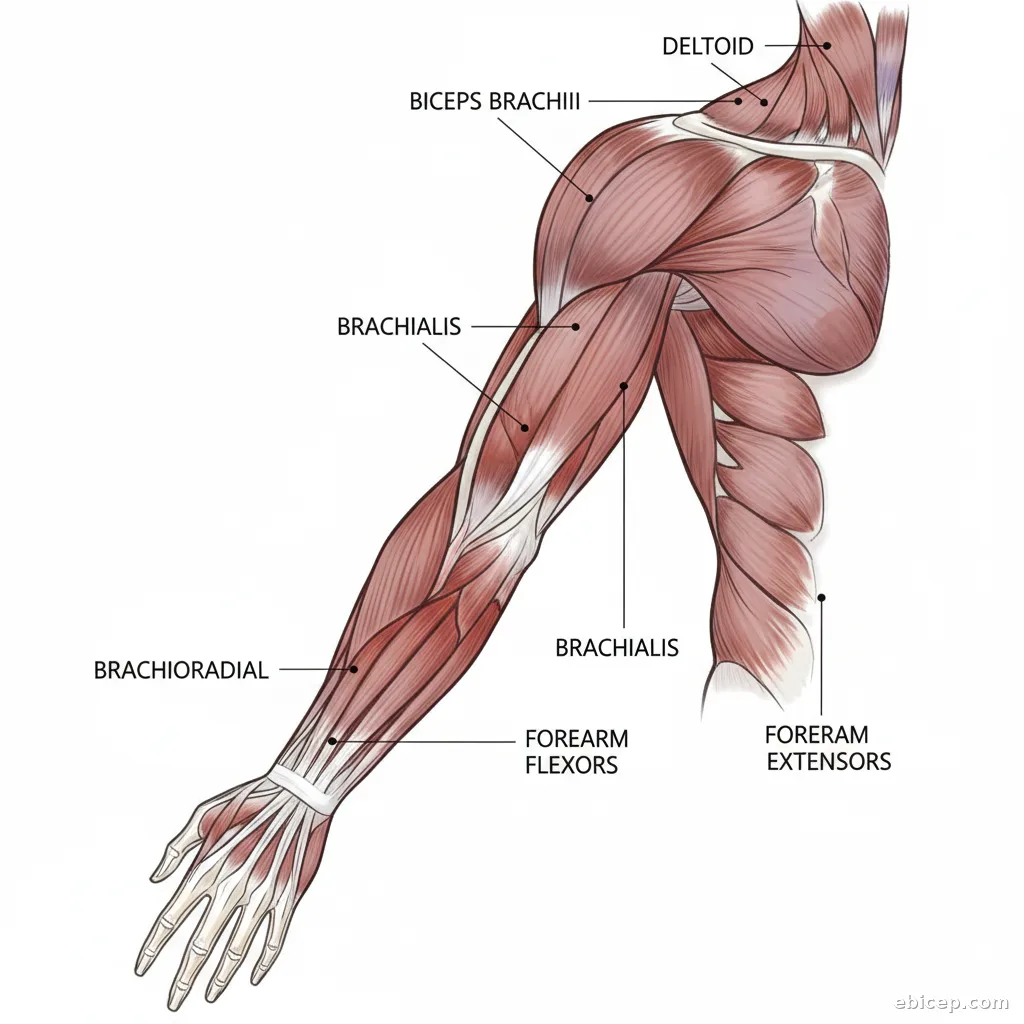
Here's every muscle in the arm labeled, organized by location, with what each one does and why it matters for training.
Upper Arm Muscles: Anterior Compartment (Front)
The front of your upper arm contains the muscles responsible for flexion — bending your elbow and bringing your forearm toward your shoulder. These are the muscles you see when you flex in a mirror.
Biceps Brachii
The most well-known arm muscle. The biceps brachii has two heads — a long head on the outer arm and a short head on the inner arm. Both heads originate at the scapula (shoulder blade) and insert at the radius) bone in the forearm.
What it does: Flexes the elbow (bending your arm), supinates the forearm (rotating your palm upward), and assists with shoulder flexion (raising your arm forward). Every curl variation targets the biceps brachii.
Why it matters for training: The two heads respond to different arm positions. Arms behind the body (incline curls) emphasize the long head. Arms in front (spider curls, preacher curls) emphasize the short head. Training both positions builds a complete bicep.
Brachialis
The brachialis sits underneath the biceps. It's a pure elbow flexor — it doesn't care about wrist rotation, just bending and straightening the arm. It originates on the front of the humerus (upper arm bone) and inserts on the ulna.
What it does: Flexes the elbow. That's it. But it contributes significantly to arm thickness when developed, because it pushes the biceps up from underneath.
Why it matters for training: Hammer curls and reverse curls target the brachialis more than standard bicep curls. If your arms look flat from the side despite having decent biceps, underdeveloped brachialis is often the reason.
Coracobrachialis
The coracobrachialis is the smallest muscle in the anterior compartment. It runs from the coracoid process of the scapula to the middle of the humerus. Most people have never heard of it.
What it does: Assists with shoulder flexion and adduction (bringing your arm across your body). It's a stabilizer, not a prime mover.
Why it matters for training: It doesn't need direct training. It gets worked during pressing movements and any exercise that involves moving your arm forward and inward. Knowing it exists helps you understand that not every muscle needs its own exercise.
Upper Arm Muscles: Posterior Compartment (Back)
The back of your upper arm houses the muscles responsible for extension — straightening your elbow.
Triceps Brachii
The triceps brachii has three heads — long head, lateral head, and medial head. Together, they make up roughly two-thirds of your upper arm mass. If you want bigger arms, the triceps matter more than the biceps from a pure size standpoint.
What it does: Extends the elbow (straightening your arm). The long head also assists with shoulder extension (pulling your arm backward). Every pressing and pushing movement — bench press, overhead press, push-ups — involves the triceps.
Why it matters for training: Each head responds to different positions. Overhead extensions emphasize the long head. Pushdowns emphasize the lateral head. Close-grip pressing hits all three. A complete arm program trains all three tricep heads, not just the ones you can see in the mirror.
Anconeus
A small muscle at the back of the elbow that assists the triceps with elbow extension. It also stabilizes the elbow joint during forearm rotation.
Why it matters for training: It doesn't require direct work. It develops alongside the triceps through normal pressing and extension exercises. Think of it as the triceps' quiet assistant.
Forearm Muscles: Anterior Compartment (Front)
The front of the forearm contains the flexor muscles — they bend the wrist and close the fingers. There are several layers, but these are the ones that matter most for training.
Brachioradialis
The brachioradialis is the meaty muscle on the thumb-side of your forearm. It crosses the elbow joint, which means it assists with elbow flexion in addition to its forearm duties.
What it does: Flexes the elbow (especially when the forearm is in a neutral or pronated position) and stabilizes the wrist during gripping movements.
Why it matters for training: Hammer curls and reverse curls are the best exercises for the brachioradialis. It's the muscle that gives your forearms that thick, powerful look from the side.
Forearm Flexors
A group of muscles including the flexor carpi radialis, flexor carpi ulnaris, palmaris longus, and flexor digitorum superficialis. They originate near the medial epicondyle of the humerus (the bony bump on the inner elbow) and run down to the hand.
What they do: Flex the wrist (curling it forward), close the fingers, and provide grip strength. Every pulling exercise — rows, deadlifts, curls — relies on forearm flexor strength for grip.
Why they matter for training: Wrist curls, farmer's carries, and dead hangs build forearm flexor strength. Weak forearm flexors limit how heavy you can go on pulling exercises because your grip gives out before the target muscle does.
Forearm Muscles: Posterior Compartment (Back)
Forearm Extensors
A group of muscles on the back of the forearm including the extensor carpi radialis, extensor carpi ulnaris, and extensor digitorum. They originate near the lateral epicondyle (outer elbow bump).
What they do: Extend the wrist (bending it backward) and open the fingers. They're the counterbalance to the flexors.
Why they matter for training: Reverse wrist curls and reverse curls develop the extensors. Balanced forearm development — flexors and extensors — helps prevent elbow tendinitis and other overuse injuries common in lifters.
Arm Movements: What Each Muscle Controls
Understanding which muscles control which arm movements helps you pick exercises more intelligently.
Elbow flexion (bending the arm): Biceps brachii, brachialis, brachioradialis. This is the curling motion — every curl variation works these three muscles to varying degrees.
Elbow extension (straightening the arm): Triceps brachii, anconeus. Every pressing and pushing movement. Tricep pushdowns, dips, bench press.
Forearm supination (rotating palm up): Biceps brachii, supinator muscle. This is why standard curls with a supinated grip hit the biceps harder than hammer curls.
Forearm pronation (rotating palm down): Pronator teres, pronator quadratus. Reverse curls train this pattern.
Wrist flexion (curling wrist forward): Forearm flexors. Wrist curls.
Wrist extension (bending wrist back): Forearm extensors. Reverse wrist curls.
Coach's Note: You don't need to memorize every Latin name. What matters is understanding the three big groups — biceps group (front of upper arm), triceps group (back of upper arm), and forearm muscles. Know that the biceps bend your arm, the triceps straighten it, and the forearms control your grip and wrist. That's enough anatomy to train intelligently.
How to Keep Your Arm Muscles Healthy
Train both sides of the arm. Biceps and triceps, forearm flexors and extensors. Imbalances between opposing muscle groups are a common cause of elbow pain and tendon injuries) in lifters.
Don't ignore your forearms. Weak forearms limit your performance on every pulling exercise and increase injury risk. A few sets of wrist curls and farmer's carries per week is enough.
Warm up before heavy arm work. Light curls, band pull-aparts, and wrist circles before jumping into heavy sets. Your elbow tendons take longer to warm up than the muscles they're attached to.
Stretch and recover. Tight biceps and forearms contribute to elbow issues over time. Stretch after training, especially if you spend time at a desk during the day.
Frequently Asked Questions
What are the main muscles in the arm?
The main upper arm muscles are the biceps brachii and brachialis (front) and the triceps brachii (back). The main forearm muscles are the brachioradialis, forearm flexors (front), and forearm extensors (back). Together, these muscle groups control elbow flexion, extension, wrist movement, and grip.
What are arm muscles called?
The front upper arm muscles are the biceps brachii, brachialis, and coracobrachialis. The back upper arm muscle is the triceps brachii. The forearm contains the brachioradialis, flexor groups, and extensor groups. In everyday language, people usually just say biceps, triceps, and forearms.
How many muscles are in the arm?
The arm contains over twenty individual muscles between the upper arm and forearm. The upper arm has four — biceps brachii, brachialis, coracobrachialis, and triceps brachii. The forearm has approximately twenty more, arranged in flexor and extensor groups across multiple layers.
What muscle is between the bicep and tricep?
The brachialis sits between the biceps (front) and triceps (back) on the outer side of the upper arm. It's primarily an elbow flexor and contributes to arm thickness when developed. Hammer curls and reverse curls are the best exercises to target it.
Why is arm muscle anatomy important for training?
Understanding which muscles perform which movements helps you select exercises that target weak points. For example, if your arms lack thickness, you know to train the brachialis with hammer curls — not just do more standard bicep curls. Anatomy knowledge turns random workouts into targeted training.
The Bottom Line
Your arm contains four upper arm muscles and roughly twenty forearm muscles, all working together to bend, straighten, rotate, and grip. For training purposes, focus on the big three groups — biceps (front of upper arm), triceps (back of upper arm), and forearms. Train both sides of each joint, don't skip forearm work, and use different grip positions to hit all the muscle heads. You don't need to know every Latin name — just understand what each group does, and your exercise selection gets smarter immediately.