Most lifters have measured their biceps at least once. Most of them did it wrong.
Not because the process is complicated — it's literally wrapping a tape measure around your arm — but because small differences in technique change the number by a full inch or more. Flexed vs relaxed, cold vs pumped, where exactly on the arm you measure, how tight you pull the tape. Get any of these wrong and you're either lying to yourself or selling yourself short.
Here's how to measure your biceps accurately, what the average bicep size actually is, and how to use your measurements to track real progress.
What You Need Before You Measure Your Biceps
You only need two things:
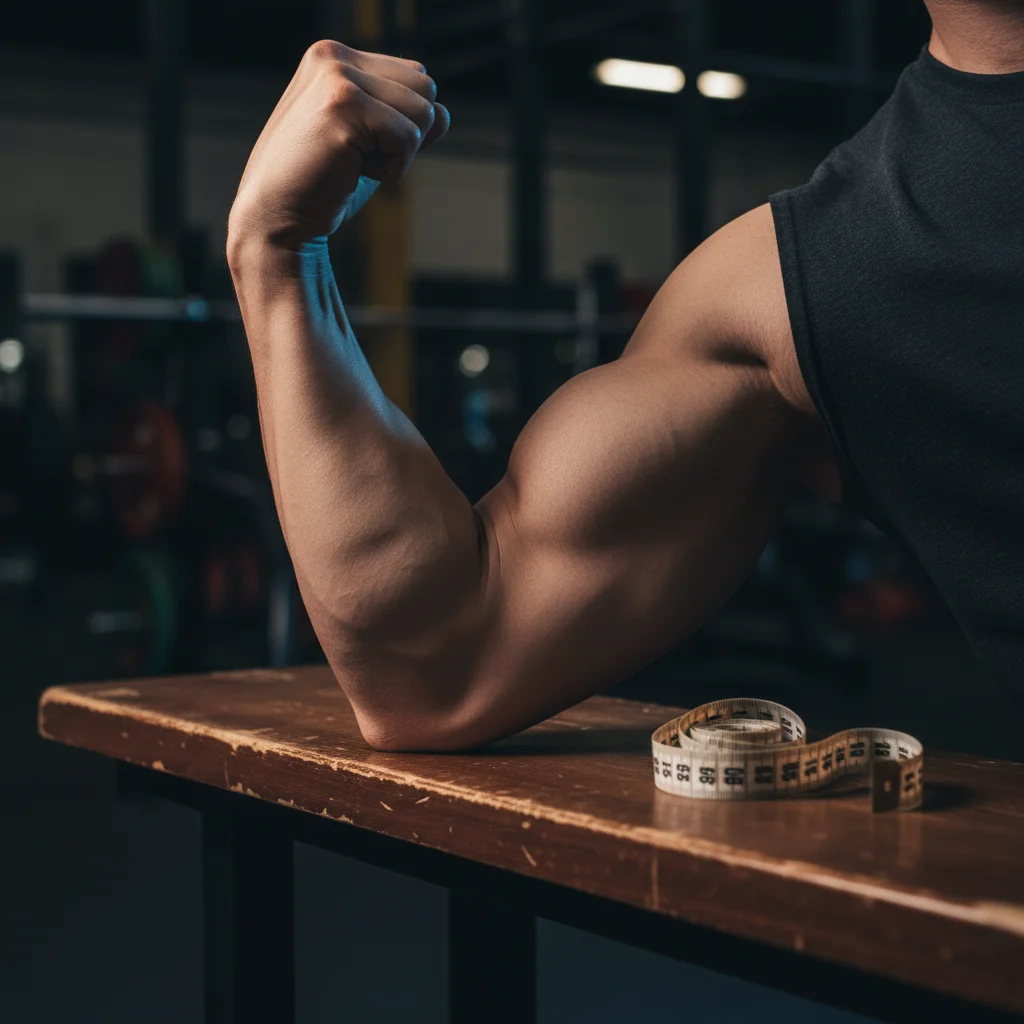
**A flexible tape measure.** The soft fabric or vinyl kind used in sewing — not a rigid construction tape measure. A rigid tape won't conform to your arm's shape and will give you an inaccurate reading. If you don't have a flexible tape, a piece of string wrapped around your arm and then measured against a ruler works in a pinch.
**A mirror (optional but helpful).** If you're measuring by yourself, a mirror helps you confirm the tape is level and not angled across your arm. An angled tape reads longer than the actual circumference.
That's it. No calipers, no body fat percentage calculations, no apps. Just a tape measure and your arm.
How to Measure Biceps: Step by Step
The Right Way to Measure (Flexed)
The standard way to measure bicep size is flexed, because that's the measurement most people reference and compare. Here's the process:
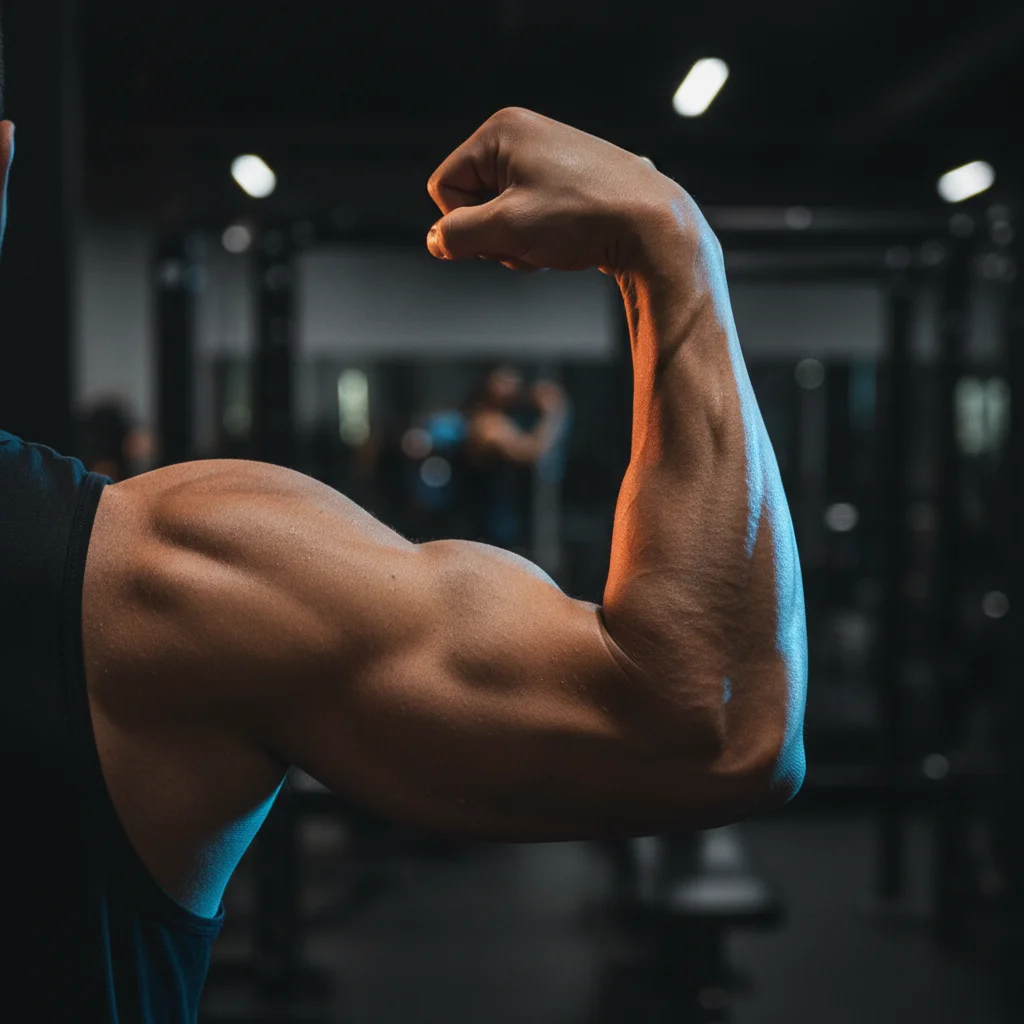
**Step 1:** Stand upright with your arm extended to the side, then bend your elbow to roughly 90 degrees — like you're doing a front double bicep pose.
**Step 2:** Flex your bicep hard. Not a half-flex — squeeze as if you're trying to impress someone. The peak of the bicep should be clearly visible.
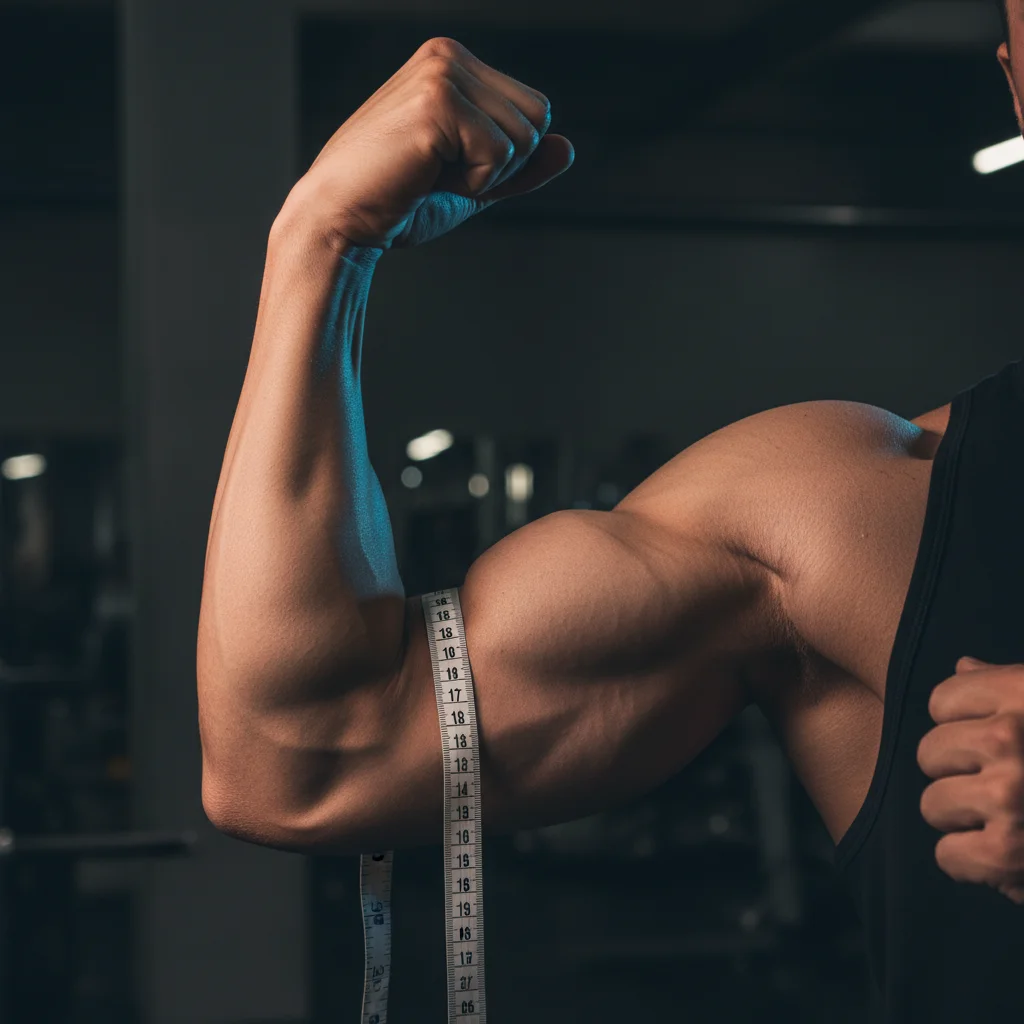
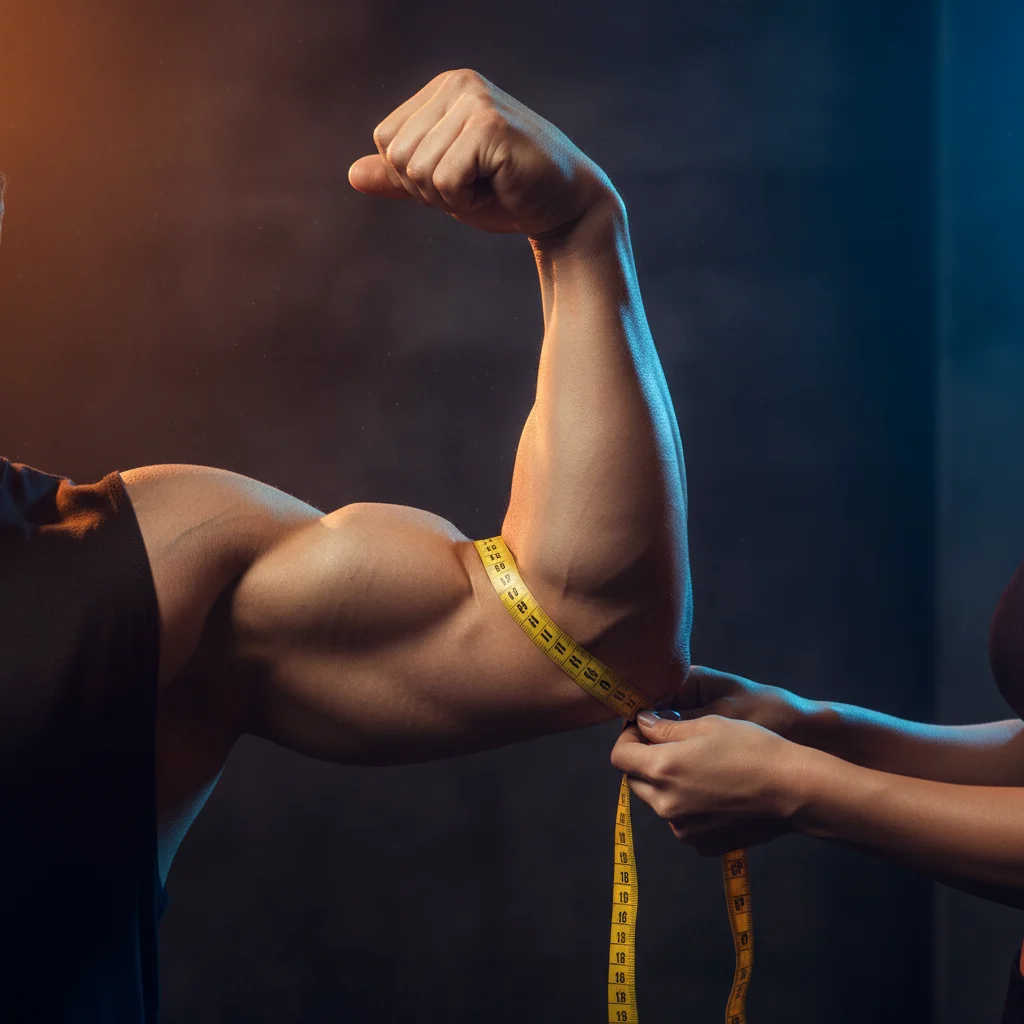
**Step 3:** Wrap the tape measure around the thickest part of your upper arm. This is typically right at the peak of the biceps, which sits roughly in the middle of the upper arm between the shoulder and the elbow.
**Step 4:** Pull the tape snug but not tight. It should make full contact with your skin all the way around without compressing the muscle. If the tape digs into your arm, you're pulling too hard and the measurement will read small.
**Step 5:** Read the measurement where the tape overlaps. That's your flexed bicep circumference.
How to Measure Relaxed Biceps
Some people also track relaxed measurements to monitor overall arm growth independent of contraction ability.
**Step 1:** Let your arm hang naturally at your side, completely relaxed. Don't flex, don't tense, don't make a fist.
**Step 2:** Wrap the tape around the thickest part of the upper arm — same location as the flexed measurement.
**Step 3:** Read the measurement. Your relaxed number will typically be 1-2 inches smaller than your flexed measurement.
Measuring for Clothing and Shirts
If you're measuring your bicep for a dress shirt, suit jacket, or clothing sizing, the technique is slightly different. Clothing measurements are usually taken relaxed with your arm at your side, and the tape is positioned around the fullest part of the upper arm. Some brands measure at the mid-bicep point specifically. Check the brand's sizing guide — each one defines "bicep measurement" slightly differently.
Coach's Note: Always measure the same arm, same way, same time of day. Your arms can vary by half an inch between morning and evening just from daily activity and hydration. Pick a routine — like every Sunday morning before eating — and stick with it. Consistency in measurement matters more than the number itself.
Flexed vs Relaxed: Which Measurement Actually Matters?
Both have value, but they tell you different things.
**Flexed measurement** reflects your bicep peak and overall arm size under contraction. This is the number people use when they say "I have 15-inch arms." It's the standard reference in bodybuilding, fitness communities, and casual gym conversation. If someone asks your arm size, this is the number they expect.
**Relaxed measurement** reflects your baseline arm mass without contraction. It's less influenced by your ability to flex hard (which is partly a skill) and more reflective of actual muscle tissue volume. Some lifters prefer tracking relaxed measurements because they're more consistent — you can't accidentally flex harder one month and get a false reading.
**The practical answer:** Track flexed for motivation and comparison. Track relaxed for accuracy. If both numbers are going up over time, your arms are growing. If flexed goes up but relaxed stays the same, you might just be getting better at flexing.
Where Exactly on the Arm Should You Measure?
This is where most measurement errors happen.
**The correct position** is the thickest part of the upper arm when flexed. For most people, this is at or just above the midpoint between the tip of the shoulder and the crook of the elbow. It's where the bicep peak sits at its highest point.
**Common mistakes:**
- Measuring too high (near the shoulder) includes deltoid tissue and inflates the number
- Measuring too low (near the elbow) misses the thickest part of the muscle belly
- Measuring at a different spot each time makes progress tracking meaningless
If you're unsure, flex your arm, look in a mirror, and find where the bicep is visibly thickest. That's your measurement point. Mark it mentally or use a small dot with a washable marker if you want to be precise.
Average Bicep Size: How Do You Compare?
These aren't perfect numbers — different studies land in slightly different places — but they're close enough to give you a real benchmark. Average bicep size by age varies, and your frame, height, body fat percentage, and training history all affect where you fall. For a full breakdown of biceps sizes by age group, see our dedicated guide.
**Average male bicep size (untrained):** 12-13 inches flexed. This is a typical arm for a man who doesn't lift weights regularly. If you're starting here, don't be discouraged — most impressive arms in the gym started at exactly this number.
**Average male bicep size (trained):** 14-16 inches flexed. After 1-3 years of consistent strength training, most men land in this range. 15-inch arms is often considered the milestone where arms start looking "big" in a T-shirt.
**Average female bicep size (untrained):** 10-11 inches flexed.
**Average female bicep size (trained):** 12-14 inches flexed. Women typically carry less muscle mass in the arms, but trained female arms with 13+ inches are genuinely impressive and reflect serious dedication.
**Competitive bodybuilders:** 17-22 inches flexed, depending on weight class and division. These numbers require years of dedicated bodybuilding, optimized nutrition, and often elite genetics.
For more detailed breakdowns by age, check our average bicep size guide.
How Often Should You Measure Your Biceps?
**Once per month** is the ideal frequency. Arms grow slowly — even under optimal training conditions, you might gain 0.25-0.5 inches per month as a beginner and even less as you advance. Measuring weekly creates noise in the data (daily fluctuations in hydration and pump) and can be demoralizing when the number doesn't move.
Monthly measurements smooth out the variability and give you a meaningful trendline. If you're gaining 0.25 inches per month, that's 3 inches in a year — a dramatic transformation that you'd miss if you were obsessing over weekly fluctuations.
**When to measure:** At the same time of day, on the same day of the week, before training (not after — the pump adds temporary size), and ideally in the morning before eating. This controlled approach gives you the most accurate comparison across months.
Tips for the Most Accurate Bicep Measurement
**Don't measure after a workout.** The pump temporarily increases arm circumference by 0.5-1 inch. Measuring post-workout feels great but doesn't reflect your actual arm size. Measure cold for honest numbers.
**Use the same arm every time.** Most people have one arm that's slightly bigger than the other — usually the dominant arm. Pick one and stick with it for all tracking purposes.
**Don't suck in or angle the tape.** The tape should sit level all the way around your arm, perpendicular to the bone. Angling it diagonally adds length and gives a falsely large reading.
**Pull the tape snug, not tight.** The tape should touch your skin without compressing the muscle underneath. If you're leaving marks on your arm, you're pulling too tight.
**Take the measurement twice.** Measure once, note the number, release the tape, then measure again. If both readings match within a quarter inch, use the average. If they're further apart, your technique needs work.
What Is Considered a Good Bicep Size?
"Good" depends entirely on context. Here's a rough framework:
**12-13 inches** is average for an untrained male. There's no shame in starting here — this is where everyone begins.
**14 inches** means you've been training and it shows. Your arms have visible shape and some definition, especially if your body fat is reasonable.
**15 inches** is where arms start looking genuinely big. Sleeves fit tighter, people notice, and you've crossed from "works out" to "clearly lifts."
**16-17 inches** is impressive by any standard. You've been training seriously for years, your nutrition is dialed in, and your arm development is well above average.
**18+ inches** puts you in rare territory. Very few natural lifters achieve this without being very tall or carrying significant body fat. At this level, you've likely been training for 5+ years with consistent dedication.
Remember: arm size without context is meaningless. A 13-inch arm at 10% body fat looks dramatically different from a 15-inch arm at 25% body fat. Leanness makes arms look bigger than raw circumference alone. And don't forget — your arm measurement includes your triceps, which make up roughly two-thirds of your upper arm mass. Growing both sides of the arm is what actually pushes the tape measure number up.
Your overall body weight matters too — your body mass index, frame size, and total mass all play a role. A heavier person at the same body fat percentage will naturally have larger arm measurements simply due to having more tissue on the frame.
How to Grow Your Biceps After Measuring
If your measurement isn't where you want it, here's what actually moves the number:
**Train biceps twice per week** with 10-16 total sets. Split across a pull day and an arm day for best results.
**Use multiple curl variations.** Barbell curls for heavy loading, incline curls for long head stretch, hammer curls for brachialis thickness. Different exercises grow the arm from different angles.
**Eat enough.** Biceps can't grow without a calorie surplus. If your weight isn't gradually increasing, your arms won't either — regardless of how well you train.
**Be patient.** Arm growth is measured in fractions of an inch per month. The tape measure is a long-game tool, not a weekly scoreboard. Trust the process, train hard, and the measurements will follow.
Frequently Asked Questions
Do you measure biceps flexed or relaxed?
Both are valid, but flexed is the standard. When someone says they have "16-inch arms," they mean flexed. For tracking progress, measuring both gives you a more complete picture — flexed shows peak size, relaxed shows baseline mass.
Is a 14-inch bicep big?
For an average adult male, 14 inches is above average and indicates regular training. It's not "big" by bodybuilding standards, but it's a solid, visible arm that looks good in a fitted shirt. For women, 14 inches is well above average and indicates serious training commitment.
How accurate are tape measure readings?
With consistent technique, a tape measure is accurate within about a quarter inch — which is precise enough for tracking monthly progress. The key is consistency: same arm, same position, same time, same tension on the tape. The absolute number matters less than the trend over time.
Can I measure my biceps by myself?
Yes. Stand in front of a mirror, flex your arm, and wrap the tape around the thickest point with your free hand. The mirror helps confirm the tape is level. It takes a few tries to get comfortable with the mechanics, but solo measurements are just as valid as having someone else do it.
The Bottom Line
Measuring your biceps is simple: flex, wrap the tape around the thickest part of your upper arm, pull snug but not tight, and read the number. The measurement itself takes 10 seconds. What matters more is doing it the same way every time — same arm, same position, same time of day, once per month. That's how you separate real growth from noise. And if the number isn't where you want it yet? Good. Now you have a baseline. The only direction from here is up.