The cable bicep curl does something that dumbbells and barbells can't — it keeps tension on your biceps through the entire rep. No dead zones at the top. No rest at the bottom. Just constant resistance from start to finish.
That's why cable arm curls feel harder than they should for the weight you're using. And that's exactly why they work so well for building bigger arms.
Here's how to do them right, which variations actually matter, and how to build a complete bicep cable workout around the cable machine.
What Is a Cable Bicep Curl?
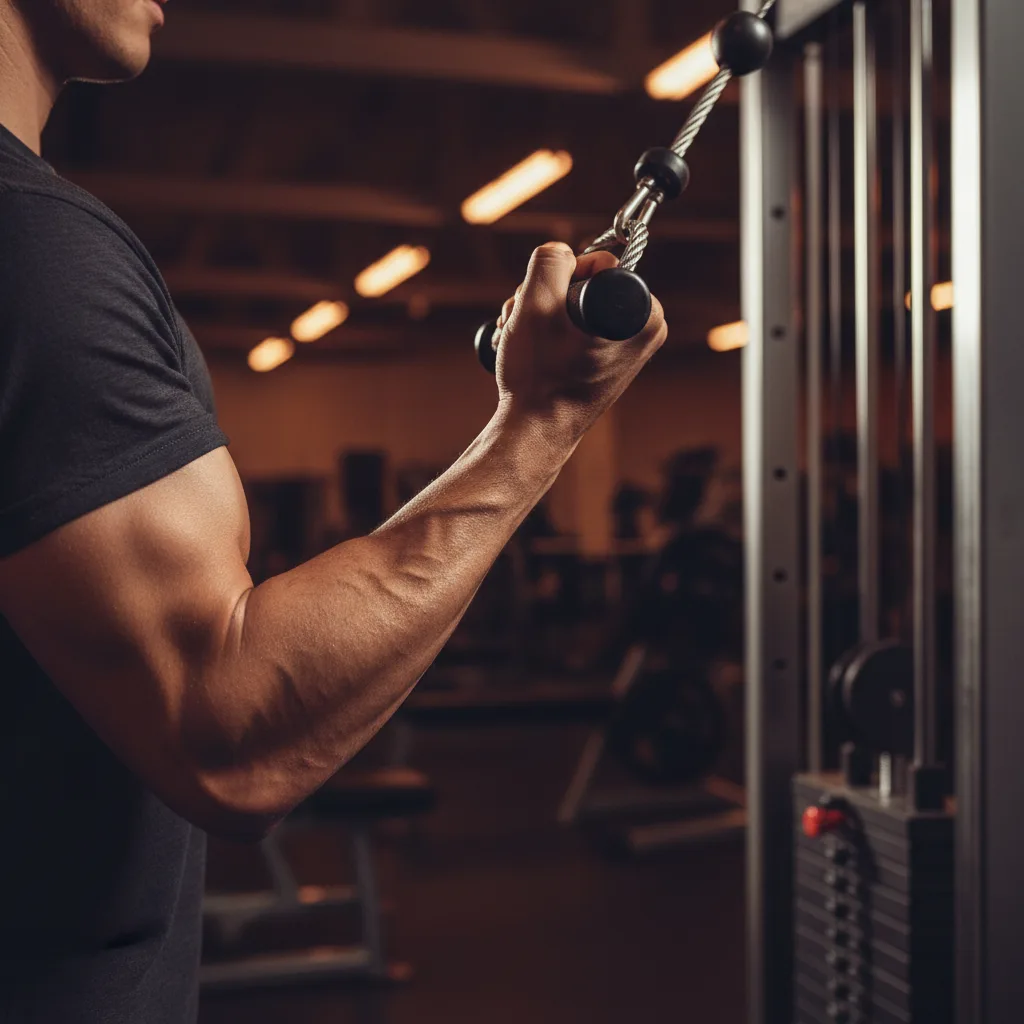
A cable bicep curl is any curling movement performed on a cable machine. You set the pulley to the bottom position, attach a handle or bar, grab it with an underhand grip, and curl the weight up by flexing at the elbow.
The cable runs through a pulley system that provides smooth, constant tension throughout the range of motion. Unlike a dumbbell curl — where gravity only pulls straight down — the cable pulls at an angle determined by the pulley position. That angle is what makes cable curls unique.
Your biceps brachii never gets a chance to rest during the rep. At the bottom of a dumbbell curl, the weight hangs straight down and your bicep is basically off. At the bottom of a cable curl, the cable is still pulling. That constant tension is the main reason cable machine curls are so effective for muscle growth.
Muscles Worked in the Cable Bicep Curl
The cable bicep curl primarily targets the biceps brachii — the two-headed muscle on the front of your upper arm. But it doesn't work alone.
Biceps brachii (long head and short head). The primary mover. The long head runs along the outside of your arm and contributes to the bicep peak. The short head sits on the inside and adds width. Both heads work together during cable curls, though you can shift emphasis with different variations.
Brachialis. This muscle sits underneath the biceps. It's a pure elbow flexor — meaning it helps bend your arm regardless of wrist position. The brachialis gets more involved when you use a neutral or pronated grip, like during cable rope biceps curls.
Brachioradialis. The thick muscle on the thumb-side of your forearm. It assists in elbow flexion and gets recruited more with heavier weight and neutral or overhand grips.
Forearm flexors. Your grip strength and forearm muscles work throughout every cable curl variation to hold onto the attachment. Heavier cable machine bicep exercises will challenge your grip almost as much as your biceps.
How to Do the Cable Bicep Curl (Straight Bar)
This is the standard version. Master this before moving to variations.
Setup. Set the pulley to the lowest position on the cable machine. Attach a straight bar or EZ bar attachment. Stand about a foot away from the machine, feet shoulder-width apart.
Starting position. Grab the bar with an underhand grip, hands about shoulder-width apart. Stand tall with your chest up, shoulders back, and elbows pinned to your sides. Let your arms extend fully — you should already feel a slight stretch in your biceps from the cable tension.
The curl. Flex at the elbows and curl the bar toward your shoulders. Keep your upper arms completely still — only your forearms should move. Squeeze your biceps hard at the top.
The lowering phase. This is where most people mess up. Lower the weight slowly — about 2 to 3 seconds on the way down. Fight the cable pulling your arms back to the starting position. This eccentric contraction is where a lot of the muscle-building stimulus happens.
Reps and weight. Start with a weight you can control for 10 to 12 reps with perfect form. If your elbows drift forward or your torso starts swinging, it's too heavy.
Best Cable Bicep Exercises and Variations
Not all cable curl variations are created equal. Here are the ones worth your time, and what each one does differently.
Cable Rope Biceps Curl
Attach a rope handle to the low pulley. Grab each end of the rope with a neutral grip (palms facing each other) and curl up. At the top, split the rope apart and rotate your pinkies outward — this supination at the peak adds extra bicep contraction that you can't get with a fixed bar.
The rope attachment also recruits the brachialis and brachioradialis more than a straight bar because of the neutral starting grip. If you want thicker arms from the front, cable rope biceps curls are your best friend.
Single-Arm Cable Curls
Using a D-handle attachment on the low pulley, curl one arm at a time. This fixes left-to-right imbalances because your stronger arm can't compensate for the weaker one — the same benefit you get from dumbbell curls but with the added constant tension of the cable.
Single-arm cable curls also let you angle your body slightly to change the resistance curve. Step to the side and you'll feel a different stretch at the bottom. Experiment with your positioning.
Cable Preacher Curl
Set a preacher bench in front of the low pulley. Rest your upper arm on the pad and curl the cable handle up. This is one of the best cable bicep exercises for isolating the short head because the pad removes any ability to swing or use momentum. If your gym has a preacher curl bench, pair it with the cable for a brutally effective combination.
Overhead Cable Curl
Set both pulleys to the highest position. Stand in the center and grab a handle in each hand. With your arms extended out to the sides at shoulder height, curl toward your ears. This puts your biceps in a fully shortened position at the peak — a contraction you can't replicate with free weights.
Overhead cable curls are great as a finishing exercise. Light weight, high reps, maximum squeeze. Don't go heavy here — the shoulder position makes cheating tempting and risky.
Cable Reverse Curl
Same setup as a standard cable curl, but flip your grip to overhand (palms facing down). This shifts the load away from the biceps brachii and onto the brachioradialis and brachialis. Your forearms will burn.
Reverse curls on the cable are actually better than the dumbbell version because the constant tension keeps the brachioradialis working at the bottom of the rep, where a free weight would let it rest.
Behind-the-Back Cable Curl
Stand facing away from the low pulley and grab a D-handle behind you. Curl from this stretched position. The cable pulls your arm behind your body, which lengthens the long head of the biceps more than any other cable variation.
This is an advanced bicep cable workout move. The stretch is intense, and going too heavy will pull your shoulder into an uncomfortable position. Use moderate weight, control every rep, and focus on the stretch at the bottom.
Coach's Note: Don't overthink which attachment to use. Straight bar for general bicep work. Rope for brachialis and a different feel. D-handle for single-arm work. EZ bar if straight bars bother your wrists. That's it. The exercise matters more than the handle.
Common Cable Bicep Curl Mistakes
These mistakes limit how much your biceps actually grow from cable curls. Fix them and you'll notice a difference within a few sessions.
Standing too close to the machine. If you're right on top of the cable stack, the pull angle is nearly vertical — which is basically a dumbbell curl with extra steps. Step back a foot or two so the cable pulls at an angle. That angle is the whole reason you're using the cable machine in the first place.
Letting your elbows drift forward. When your elbows move forward during the curl, your front deltoid takes over and your biceps lose tension. Pin your elbows to your sides. If they drift, the weight is too heavy.
Swinging your torso. Using momentum defeats the purpose. Cable curls are an isolation exercise. Your upper body should be still. Your biceps do the work, nothing else. Keep your core tight, chest up, and resist the urge to lean back on heavy reps.
Going too fast on the lowering phase. The negative portion of a cable curl is gold for muscle building. If you're just letting the weight slam back down, you're leaving half the exercise on the table. Take 2-3 seconds to lower. Control it.
Using too much weight. This is the most common mistake with cable machine bicep exercises. The constant tension means you'll need less weight than you use for dumbbell curls. Drop your ego, lower the pin, and actually feel your biceps working.
Benefits of Cable Curls vs Free Weights
Cable curls aren't better than dumbbell curls or barbell curls. They're different. Here's what the cable does that free weights can't.
Constant tension throughout the rep. A dumbbell curl is hardest in the middle of the range of motion and nearly effortless at the top and bottom. A cable curl maintains resistance everywhere. More time under tension means more stimulus for muscle growth.
Adjustable angle of resistance. Move the pulley up, down, or stand at different angles relative to the machine, and you change where the exercise is hardest. That's a level of customization you don't get with a barbell or dumbbell.
Easier to do drop sets and supersets. Moving a pin is faster than swapping dumbbells. When your biceps are fried at one weight, drop the pin and keep going. This makes cables ideal for high-volume bicep cable workouts and finisher sets.
Lower injury risk. Cables provide smooth, predictable resistance. There's no momentum to manage at the bottom like a heavy barbell curl, and you can't get stuck under the weight. For someone training around a shoulder issue or recovering from a minor strain, cable exercises are often the safest bicep option.
Free weights — dumbbells and barbells — still win for building raw strength training and for overloading the biceps with heavier weight. The smart approach is using both. Heavy barbell or dumbbell curls for strength, cable bicep exercises for isolation and volume.
Cable Bicep Curl Workout: Putting It Together
Here's a complete bicep workout with cable machine exercises. This covers all the angles and grip positions your biceps need to grow.
Cable Bicep Workout (20-25 minutes)
1. Cable curl with straight bar attachment — 3 sets of 10-12 reps
2. Cable rope biceps curl — 3 sets of 12-15 reps
3. Single-arm cable curl — 2 sets of 12 reps each arm
4. Overhead cable curl OR behind-the-back cable curl — 2 sets of 15 reps
Rest 60-90 seconds between sets. On the last set of each exercise, do a drop set — reduce the weight by 30% and rep to failure.
Adding Cable Curls to a Biceps Workout
If you're not doing a cable-only session, add 2-3 cable bicep exercises at the end of your pull day or arm day. Start with your heavy free weight curls — barbell curls, hammer curls — and finish with cables. The constant tension at the end of a workout, when your biceps are already fatigued, is where cables really shine.
Beginner Cable Arm Workout
If you're new to the cable machine, start simple:
1. Cable curl with EZ bar — 3 sets of 12 reps
2. Cable rope curl — 3 sets of 12 reps
That's enough. Learn the movement, focus on form, and add more variations as you get comfortable with the cable machine. Beginners don't need six exercises — they need two done well.
Cable Bicep Curl vs Dumbbell Curl vs Barbell Curl
This comes up constantly. Here's the honest breakdown.
Cable bicep curl — best for isolation, constant tension, and high-rep pump work. Hardest throughout the entire range of motion. Lower risk of injury. Ideal for the second half of a workout.
Dumbbell curl — best for unilateral work, fixing imbalances, and full supination under load. Each arm works independently. Allows more wrist freedom than a barbell.
Barbell curl — best for loading heavy weight and progressive overload. Both arms work together, so you can handle more total weight. The straight bar limits wrist movement, which some people find uncomfortable.
None of them is "the best." The best cable bicep exercises, the best dumbbell exercises, and the best barbell exercises all have a place. Use all three across your training week.
Frequently Asked Questions
Are cable bicep curls effective?
Very. If I had to pick one curl variation for pure hypertrophy, cable curls would be near the top. The constant tension makes them better than dumbbell curls for isolation work. They won't replace heavy barbell curls for strength, but for building size, cable curls are excellent.
Why is the cable bicep curl harder than a dumbbell curl?
Because the cable never lets your biceps rest. At the bottom and top of a dumbbell curl, gravity gives you a brief break. The cable doesn't. Same weight feels heavier on the cable because you're working through the full range with no dead spots.
What attachment should I use for cable bicep curls?
Straight bar for standard curls. EZ bar if your wrists hurt with a straight bar. Rope for neutral-grip work that hits the brachialis. D-handle for single-arm curls. There's no single best attachment — match it to the variation you're doing.
Do cable bicep curls work the long head or short head?
Standard cable curls with an underhand grip work both heads. Behind-the-back cable curls emphasize the long head because of the arm-behind-body stretch. Cable preacher curls emphasize the short head. The attachment and body position determine the emphasis.
How many cable bicep curls should I do?
For most people, 6-9 total sets of cable bicep exercises per week is plenty. That could be 3 sets of two different cable curl variations, twice per week. If you're also doing dumbbell and barbell curls, aim for the lower end.
Is the cable bicep curl a push or pull exercise?
It's a pull. Any movement that involves bending the elbow and bringing weight toward your body is a pulling motion. Cable curls belong on pull day or arm day.
Can you build biceps with cables only?
Yes. Cables provide enough variety and resistance for complete bicep development. You'd want at least 3-4 different cable variations to cover all angles and grips. Not optimal if you completely ignore free weights, but entirely doable.
What We Recommend
Yes4All Cable Machine Attachment Set
If your gym's attachments are always missing or you're building a home cable setup, this set covers every cable bicep curl variation in this article. Includes a straight bar, EZ curl bar, tricep rope, and V-bar — all with rotating swivels and rubber grips. Heavy-duty steel rated to 880 lbs, which is more than you'll ever curl.
The Bottom Line
Cable bicep curls deserve a spot in every arm training program. The constant tension makes them one of the most effective ways to isolate the biceps, and the variety of attachments and angles means you can hit the muscle from positions that free weights simply can't replicate. Start with the standard straight bar curl, add one or two variations that target what your arms need most, and finish your workouts with cables when your biceps are already fatigued. That's where the deep burn and real growth happen.