Incline hammer curls merge two proven concepts: the deep bicep stretch of incline curls and the brachialis emphasis of hammer curls. The result is an exercise that stretches and loads the brachialis and long head of the bicep simultaneously — a combination that few other movements achieve.
If your arms look good from the front but lack thickness from the side, incline hammer curls attack exactly that weakness.
Why the Incline + Hammer Combination Works
The incline position places your arms behind your torso, stretching the long head of the biceps and the brachialis at the bottom of each rep. Research increasingly suggests that training a muscle in its lengthened position is one of the strongest hypertrophy signals available.
The neutral (hammer) grip shifts primary elbow flexion work from the biceps brachii to the brachialis and brachioradialis. So you're getting a deep stretch on exactly the muscles responsible for arm thickness — the brachialis that sits under the bicep and pushes it upward when developed.
With standard incline curls (palms up), the biceps brachii does most of the work. Switch to the hammer grip on the same bench, and you redirect that stretch-based stimulus to the brachialis instead. Both exercises use the same bench setup but target different muscles. That's efficient programming.
Setup and Execution
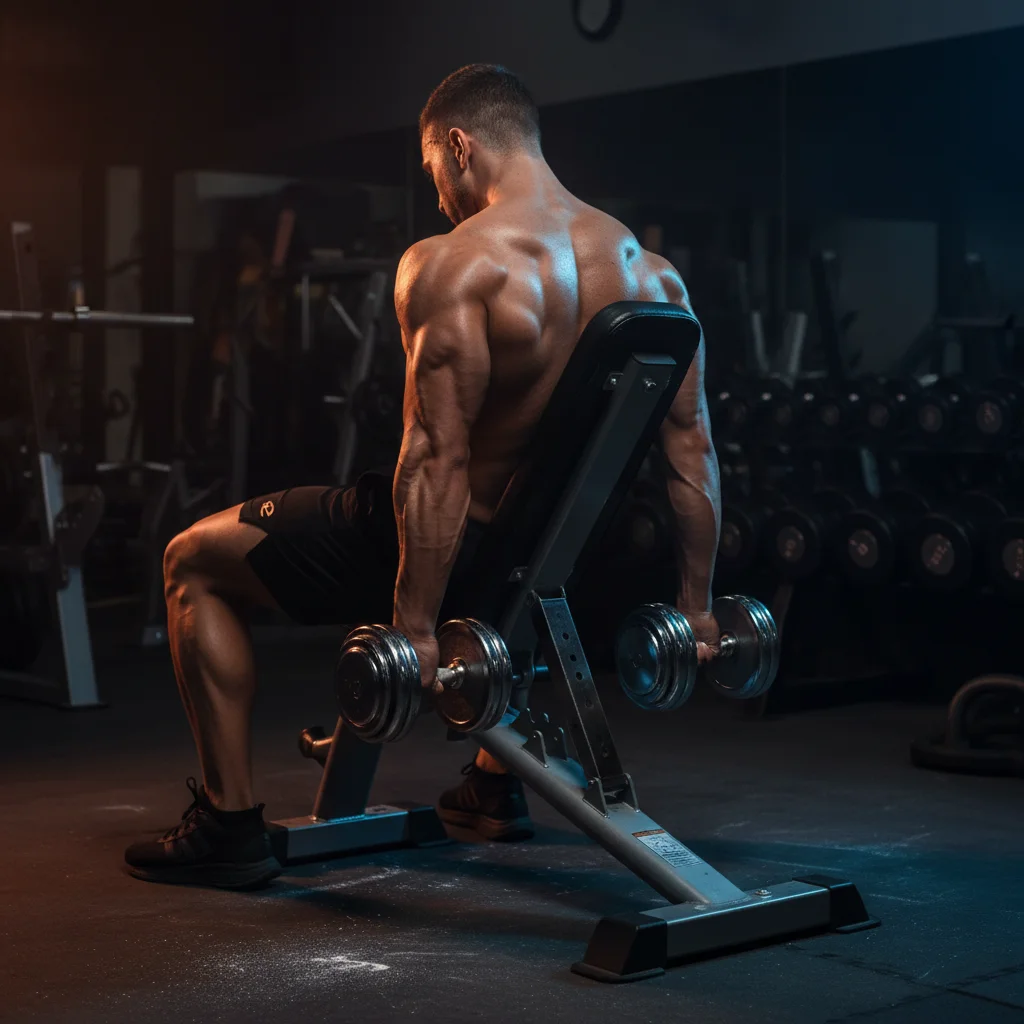
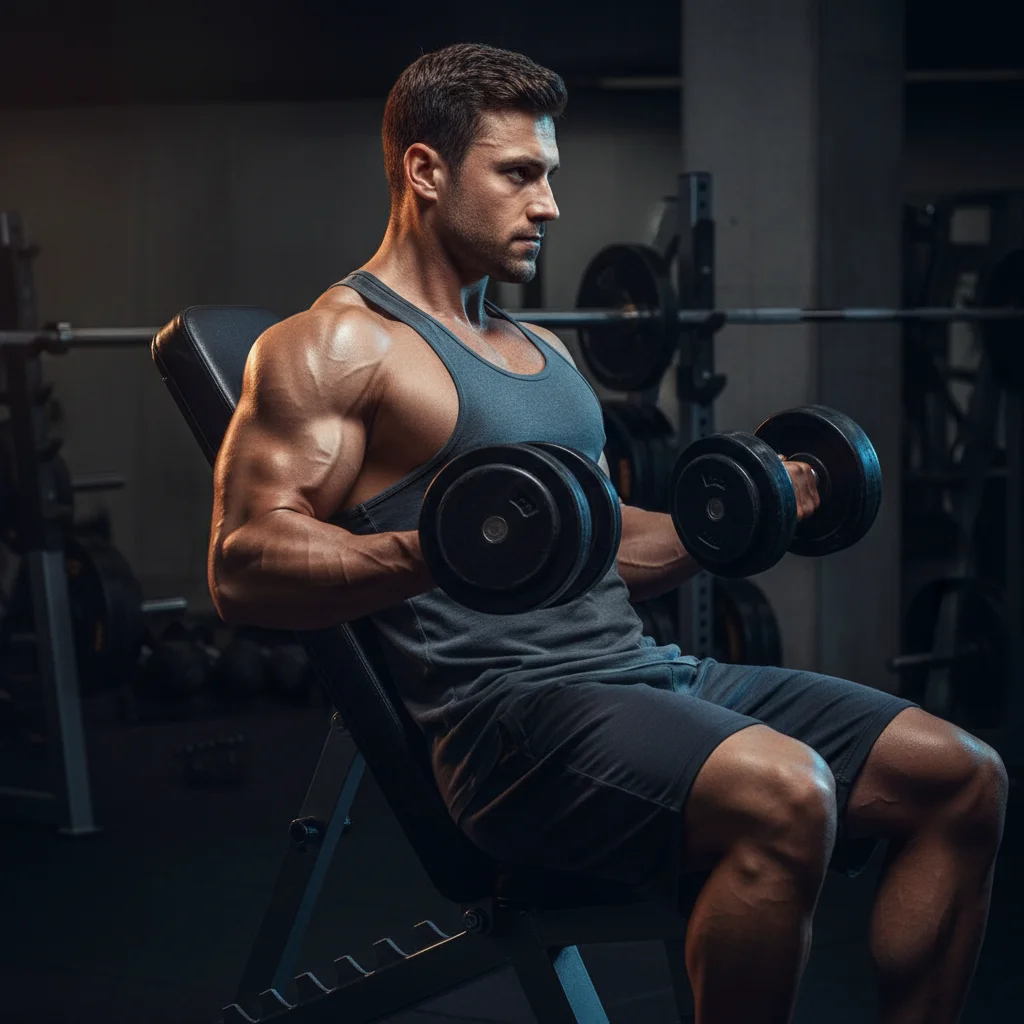
Set an adjustable bench to 45-60 degrees. Sit back with your shoulder blades firmly against the pad. Hold a dumbbell in each hand with a neutral grip — palms facing each other, thumbs pointing up. Let your arms hang straight down behind the line of your torso.
You should feel a distinct stretch through the outer part of your upper arm and into the forearm. This is the brachialis and brachioradialis being stretched, and it's the starting position for every rep.
Curl both dumbbells upward while maintaining the neutral grip. Do not rotate your wrists — palms stay facing each other throughout. Your upper arms will drift slightly forward as you approach the top, but they should stay mostly pinned in the same position relative to your torso.
Squeeze at the top, then lower slowly — 3 seconds minimum — back to the full stretch. The lowering phase under stretch is where the growth happens.
The Arm Position Test: At the bottom of the rep, look at your arm from the side. Your upper arm should be angled slightly behind the vertical line of your torso. If your arms are hanging straight down or in front of your body, the bench angle is too steep. Lower it to 45 degrees.
Bench Angle Considerations
45 degrees: Maximum stretch, maximum difficulty. Your arms hang further behind your body, creating a longer range of motion. Best for experienced lifters with healthy shoulders. You'll use the least weight at this angle.
60 degrees: Moderate stretch, more comfortable. A good starting point for most people. Still provides the arm-behind-body position that creates the stretch stimulus, but with less shoulder stress.
Start at 60 degrees. After 2-3 weeks, try 45 degrees and see how your shoulders respond. Not everyone can comfortably train at 45 — shoulder anatomy varies, and discomfort here isn't something to push through.
Weight Selection
Use less weight than you think. Incline hammer curls will humble you — the combination of stretch and neutral grip makes the exercise significantly harder than standing hammer curls.
A rough guideline: use about 55-65% of your standing hammer curl weight. If you standing hammer curl 30-pound dumbbells, start incline hammer curls at 17-20 pounds. Some people need to go even lighter. There's no shame in this — the position is doing the work, not the weight.
Common Mistakes
Rotating the grip. If you're supinating (turning palms up) during the curl, you've turned this into an incline bicep curl. Keep the neutral grip locked. Palms face each other from start to finish.
Sitting too upright. If the bench is past 70 degrees, there's no meaningful stretch. The whole point is the reclined position. You should feel the stretch before you even start curling.
Momentum at the bottom. Don't bounce out of the stretched position. The transition from eccentric to concentric should be smooth and controlled, not a whip. Pause for a beat at the bottom if needed.
Shoulder strain. If you feel sharp pain in the front of your shoulder at the bottom, raise the bench angle. If it persists at 60+ degrees, this exercise may not be appropriate for your shoulder anatomy — rope cable curls provide similar brachialis emphasis without the shoulder extension component.
Programming
Two to three sets of 10-12 reps is ideal. Place them early to mid-workout when your shoulders are fresh and stable — shoulder fatigue compromises the stretch position.
A potent arm workout pairing: incline dumbbell curls (palms up, 3x10) followed immediately by incline hammer curls (neutral grip, 3x10) on the same bench. Same setup, different grip, complete bicep and brachialis coverage. Rest 90 seconds between the superset pairs.
Don't combine incline hammer curls with Bayesian curls in the same session — both provide intense stretch-based stimuli, and the combined muscle damage can lead to excessive soreness and impaired recovery. Alternate between them week to week instead.
What We Recommend
REP Fitness AB-3000 Adjustable Bench
Same bench requirements as incline curls — stable at 45-60 degrees with no wobble under load.
The Bottom Line
Incline hammer curls are a specialist exercise for arm thickness. They stretch and load the brachialis in a way that standing hammer curls can't replicate, while also hitting the long head of the biceps through a full range of motion. Use them when your arms need more three-dimensional development — the kind of thickness that looks impressive without flexing.