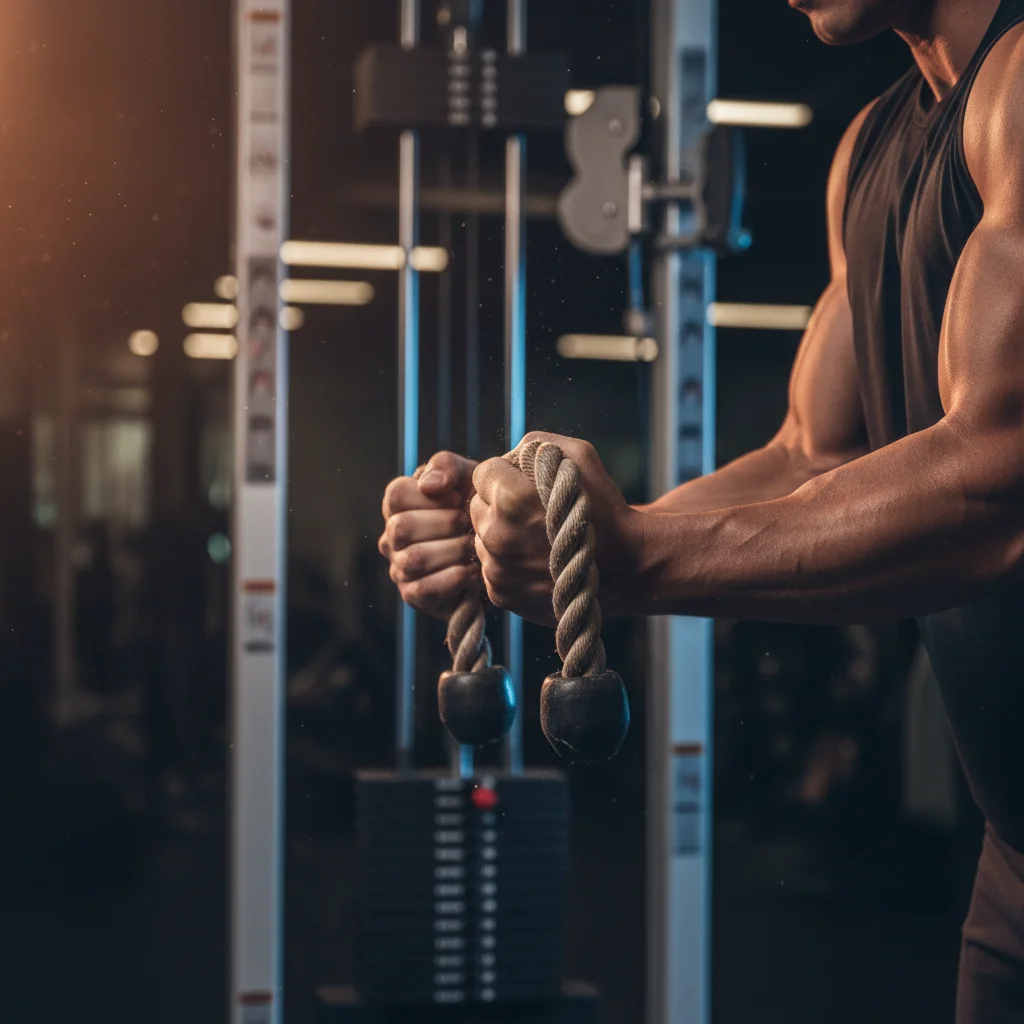
Rope cable curls combine the neutral grip of hammer curls with the constant tension of cable curls. The result is an exercise that keeps your brachialis and brachioradialis under continuous load — something dumbbell hammer curls can't fully achieve because of gravity's limitations.
The rope attachment also allows a unique finishing squeeze that no other curl variation can replicate.
Why the Rope Attachment Changes Things
Two features make the rope special. First, the independent rope ends let each hand move freely, which means each arm must stabilize independently. If your left arm is weaker than your right, you'll feel it immediately — the rope doesn't let the strong arm compensate the way a bar does.
Second, the rope allows you to spread the ends apart at the top of the curl. This outward pull creates an extra contraction in the brachialis that you simply can't get with a fixed bar or dumbbell. It's a small movement that creates a significant burn.
Combined with the cable's constant tension, you get an exercise where the target muscles are never resting during any portion of the rep.
How to Perform Rope Cable Curls
Attach a rope to the lowest pulley position on a cable machine. Grab each end of the rope with a neutral grip — palms facing each other, thumbs pointing up toward the ceiling.
Stand about a foot away from the machine. Let your arms hang fully extended with the rope taut. Your elbows should be at your sides and stay there throughout the movement.
Curl the rope upward by bending at the elbows. As you reach the top, split the rope ends outward — pulling them apart to the sides — while squeezing hard. Hold this spread position for a full second.
Bring the rope ends back together and lower under control to the fully extended position. You should feel tension in your forearms and the outside of your upper arms the entire time.
The Split Matters: Don't just curl up and stop. The split-and-squeeze at the top is what makes this exercise different from a regular cable curl with a neutral grip. Actively pull the rope ends apart like you're trying to break the rope in half. The wider you split, the harder the contraction.
Common Mistakes
Not splitting at the top. If you're just curling the rope up and down without the outward split, you're missing the unique benefit of this exercise. You might as well use a straight bar attachment instead.
Standing too close to the machine. When you're right on top of the cable stack, the cable pulls straight up and you lose tension at the top of the curl. Step back so there's a slight angle to the cable — this keeps tension on the muscles throughout the full range.
Using too much weight. The split at the top is impossible to perform properly with heavy weight. If you can't pull the rope ends at least 6 inches apart at the peak, drop the weight. This exercise is about quality contraction, not load.
Elbows flaring out. Keep your upper arms tight to your torso. If your elbows are drifting outward, you're recruiting your shoulders. The only movement should be at the elbow joint.
Variations
Single-arm rope curls use just one end of the rope (or a single rope attachment) for pure unilateral work. This lets you focus entirely on one arm and correct any imbalances.
Overhead rope curls set the pulley high and face away from the machine. Curl toward the back of your head. This hits the biceps from a unique overhead angle and works well as a finishing exercise.
Kneeling rope curls remove any possible leg drive or hip thrust from the equation. Kneel on the floor facing the cable machine and curl — your biceps and forearms are 100% on their own.
Programming Rope Cable Curls
Rope cable curls work best in the 10-15 rep range. They're ideal as a second or third exercise in your arm workout, after heavier free weight work like barbell curls or incline dumbbell curls.
They also excel as a drop set or burnout finisher. Since changing the weight is just moving a pin, you can do rapid drop sets: 12 reps at full weight, drop 20%, 10 more reps, drop again, 8 final reps. The brachialis pump from this is intense.
If you're already doing dumbbell hammer curls in the same workout, you probably don't need rope cable curls as well — they target the same muscles. Choose one or the other, or alternate them week to week.
What We Recommend
Yes4All Tricep Rope Cable Attachment
If your gym's rope attachment is too short or too worn, a 36-inch replacement is cheap and fits any standard cable machine.
The Bottom Line
Rope cable curls take the best of hammer curls (neutral grip for brachialis) and the best of cable work (constant tension) and combine them with a unique split-and-squeeze finish. It's not a replacement for your primary curl, but as a secondary or finishing movement, it fills a gap that other exercises can't. Learn the split technique and use moderate weight — the burn will tell you it's working.