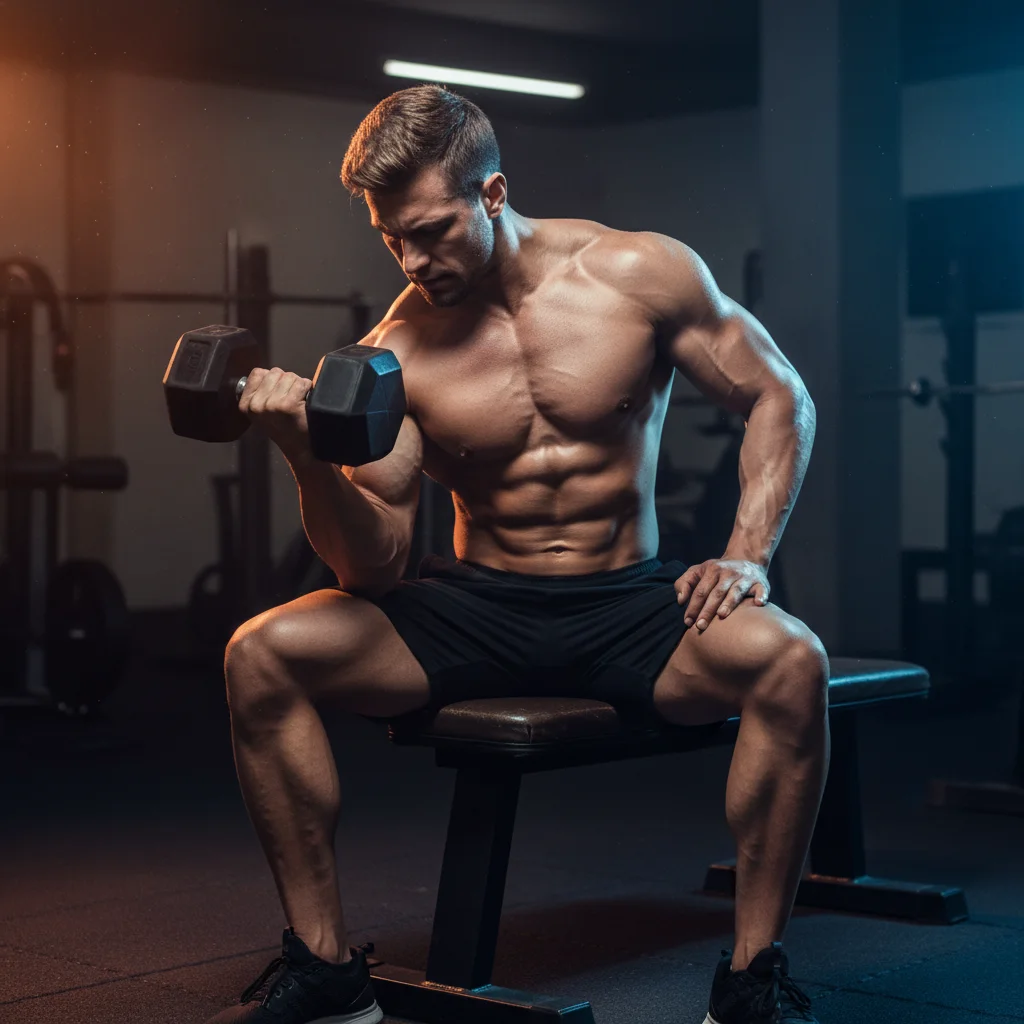
Sitting down to curl feels counterintuitive. Standing curls seem more athletic, more functional, more "hardcore." But the seated dumbbell curl exists for one reason: it forces your biceps to do the work that your legs, hips, and back steal during standing curls.
If you've ever wondered whether your bicep growth has stalled because you're unconsciously cheating on every rep, the seated curl gives you an honest answer.
Why Sitting Down Matters
Stand up and curl a heavy dumbbell. Even with your best intentions, your body will subtly lean back, shift your weight, and use momentum from your hips and core. This is normal — your nervous system automatically recruits larger muscle groups to help when the biceps struggle.
Sitting on a bench with back support removes almost all of these compensation patterns. Your back is pinned against the pad, your hips are fixed, and your legs can't generate momentum. The dumbbell goes up only if your biceps lift it.
The practical result: you'll use less weight seated than standing, but the weight that moves is doing 100% bicep work rather than 70% bicep and 30% everything else.
How to Set Up and Perform the Movement
Set an adjustable bench to 90 degrees (fully upright) with back support. Sit with your back flat against the pad, feet firmly on the floor, and a dumbbell in each hand hanging at your sides.
Starting position: arms fully extended, palms facing your thighs (neutral grip) or slightly forward. Let your arms hang naturally — don't pull your shoulders back or forward.
Curl one or both dumbbells upward. As you curl, supinate your wrist — rotate your palm from neutral to fully facing up by the time you reach the top. This rotation under load is one of the primary functions of the biceps brachii, and doing it actively against resistance maximizes muscle fiber recruitment.
Squeeze at the top with your palm fully supinated (facing the ceiling), then reverse the motion: lower the dumbbell while gradually rotating your wrist back to neutral at the bottom.
Back Pad Contact: If your shoulder blades come off the back pad during any rep, the weight is too heavy. Period. The entire purpose of the seated position is to eliminate body English — don't defeat it by leaning forward to grind out reps.
Alternating vs Simultaneous
Alternating (one arm at a time) lets you focus completely on each bicep individually. You can also handle slightly more weight because your core and stabilizers only manage one arm's worth of load. This is the more popular approach and works well for most people.
Simultaneous (both arms together) reduces workout time and creates more metabolic stress since both biceps are working continuously. However, form tends to degrade faster because managing two dumbbells is more demanding. Use this approach with lighter weight.
Either works. If you're prioritizing the mind-muscle connection and quality of contraction, alternate. If you're focused on efficiency, go simultaneous.
Common Mistakes
No supination. Curling the dumbbell straight up without rotating the wrist treats it like a hammer curl. The seated curl should include active supination to maximize bicep involvement. Turn that pinky toward the ceiling as you curl up.
Swinging the dumbbells forward. Some people initiate the curl by swinging the dumbbell forward and then up, creating a pendulum motion. Start the curl by bending the elbow — the dumbbell should travel in an arc, not a swing.
Cutting range of motion. At the bottom, let your arm fully extend. At the top, bring the dumbbell close to your shoulder. Partial reps shortchange both the stretch stimulus and the peak contraction.
Rushing the eccentric. Lower each rep for at least 2 seconds. The seated position makes eccentric control easier to maintain, so take advantage of it.
When to Use Seated Curls
Seated dumbbell curls work well as your primary curl exercise on days when you want strict form, or as a second exercise after heavy barbell curls. The forced isolation makes them a good choice when you suspect you've been cheating on standing curls.
Three sets of 8-12 reps is standard. They pair well with preacher curls (which lock your arms against a pad) for a workout built entirely around strict bicep isolation.
They're also excellent for beginners learning proper curl mechanics. The seated position provides external feedback — if you're cheating, you'll feel your back come off the pad.
The Bottom Line
The seated dumbbell curl is the honesty check of bicep training. It strips away every possible compensation and shows you exactly how strong your biceps actually are. That's humbling the first time — and extremely productive long-term. Use them regularly, and watch the gap between your standing curl weight and seated curl weight narrow. When those numbers converge, your biceps are doing the work they should have been doing all along.