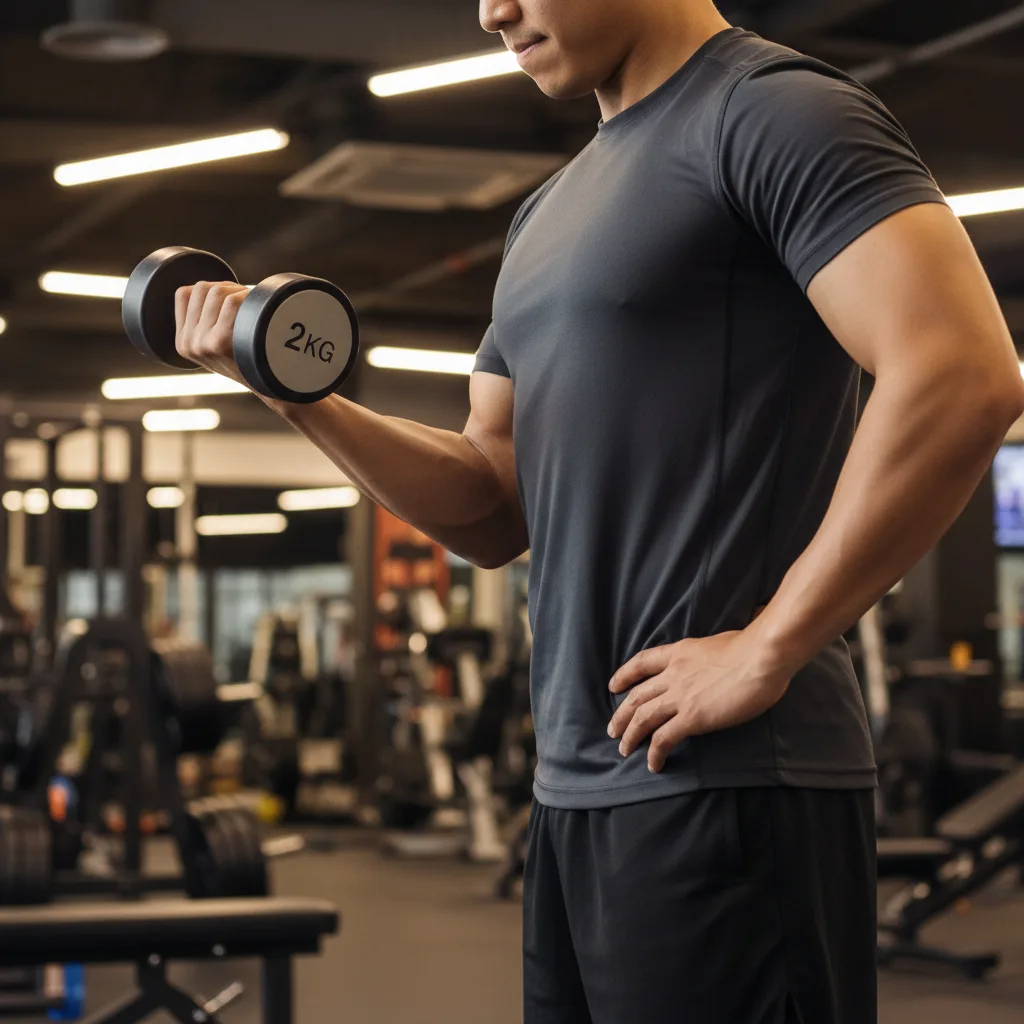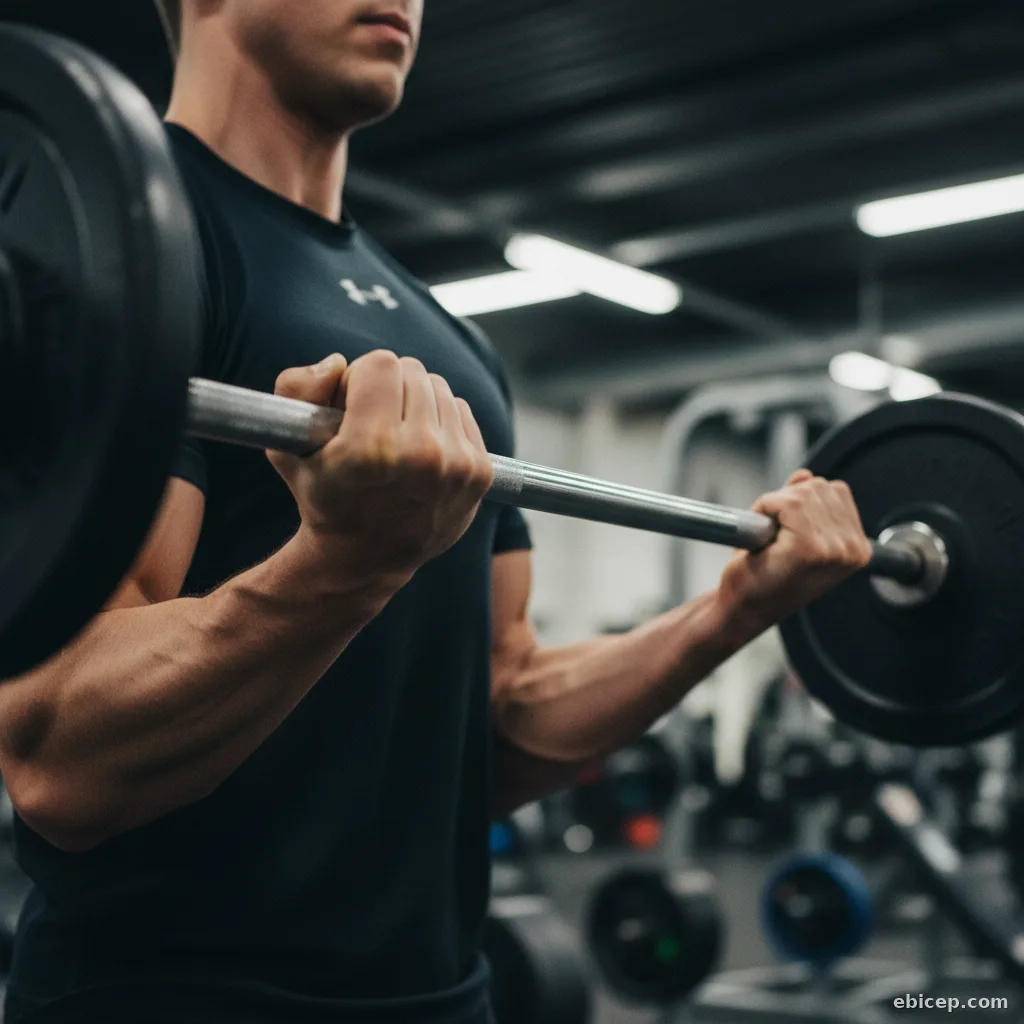
"How much should I be curling?" is one of the first questions every beginner asks — and one of the hardest to answer without context. Your curl weight depends on your body weight, training experience, exercise variation, and whether you're curling with strict form or swinging the weight up like you're trying to start a lawnmower.
Here are realistic curl weight benchmarks for every level, how to find the right starting weight, and when it's time to go heavier.
Average Curl Weight by Experience Level
These numbers are for a strict standing dumbbell curl — one arm at a time, no swinging, full range of motion. If you're using momentum, your numbers will be higher but they don't count.
Beginner Men (0-6 months)
Average dumbbell curl weight: 10-20 lbs per arm
Most men who are new to lifting can strict-curl somewhere between 10 and 20 lbs for 8-10 reps. If you're on the lighter end, that's completely normal. If you can curl 20 lbs with clean form in your first month, you're ahead of average.
Average barbell curl weight: 30-45 lbs (including the bar)
An empty EZ bar weighs about 15-25 lbs depending on the bar. Add a few small plates and you're in the right range. Most beginners don't need more than this for the first few months.
Beginner Women (0-6 months)
Average dumbbell curl weight: 5-12 lbs per arm
Starting at 5 lbs with proper form is not weak — it's smart. Many women progress to 10-12 lbs within the first two months of consistent training. The weight will come. Form first.
Average barbell curl weight: 15-25 lbs
Intermediate Lifters (6 months - 2 years)
Average dumbbell curl weight: 20-35 lbs (men) / 10-20 lbs (women)
This is where most lifters spend the majority of their training career. A 25-30 lb strict dumbbell curl is a solid intermediate benchmark for men. Reaching 35 lbs with clean form puts you above average.
Average barbell curl weight: 50-80 lbs (men) / 25-40 lbs (women)
Advanced Lifters (2+ years)
Average dumbbell curl weight: 35-50+ lbs (men) / 20-30+ lbs (women)
If you can strict-curl a 40 lb dumbbell for 8 reps, your biceps are well-developed. Anything above 45 lbs with true strict form is genuinely impressive — most lifters who claim to curl 50s are using significant body English.
Average barbell curl weight: 80-110+ lbs (men) / 40-60+ lbs (women)
Coach's Note: These numbers assume strict form — no swinging, no leaning back, elbows at your sides, full range of motion. Add momentum and everyone can curl 30-40% more. That extra weight isn't building muscle, it's building ego. Strict curl numbers are the only ones that matter.
How to Find Your Starting Curl Weight
Don't guess. Test it.
Step 1: Pick up a dumbbell you think might be too light. For most beginner men, start with 10 lbs. For most beginner women, start with 5 lbs.
Step 2: Do a set of 12 reps with strict form — no swinging, elbows pinned, full range of motion, controlled lowering.
Step 3: If you finished all 12 with room to spare, go up 2.5-5 lbs and try again. If you struggled on the last 2-3 reps, that's your working weight. If you couldn't finish 8 reps with good form, go lighter.
The right weight is one where reps 8-12 are genuinely challenging but your form stays clean. If your body starts swinging at rep 6, the weight is too heavy — no matter what the number on the dumbbell says.
Factors That Affect Your Curl Weight
Body weight. Heavier lifters generally curl more because they have more total muscle mass, including untrained mass. A 200 lb man will typically start heavier than a 150 lb man.
Training history. If you've done manual labor, sports, or any pulling-based activity, your biceps may already have a base of strength. Complete beginners with desk-job backgrounds start lighter.
Curl variation. A standing barbell curl allows more weight than a dumbbell curl because both arms share the load. An incline curl uses less weight because the stretch makes it harder. A preacher curl uses less because you can't cheat. Don't compare weights across different variations — they're different exercises.
Grip type. A supinated grip (palms up) lets you curl more because the biceps brachii is in its strongest position. A neutral grip (hammer curls) shifts work to the brachialis and brachioradialis, which are typically weaker. A pronated grip (reverse curls) is the weakest position.
Form strictness. This is the biggest variable. A strict curl with no momentum uses 20-30% less weight than a "cheat curl." That's normal and expected. The strict version builds more muscle.
How to Increase Your Curl Weight
Progressive overload is simple for curls — but it requires patience.
Add reps first. If you can curl 15 lbs for 8 reps, work up to 12 reps before jumping to 17.5 or 20 lbs. More reps with the same weight is still progression.
Go up in small increments. 2.5 lb jumps are ideal for curls. A 5 lb jump (from 15 to 20 lbs) is a 33% increase — that's huge for a small muscle group. If your gym has 17.5 lb dumbbells, use them. If not, hit 15 reps with the current weight before jumping 5 lbs.
Focus on the eccentric. Before adding weight, try slowing down the lowering phase to 3-4 seconds. This increases time under tension) without increasing load — your muscles get a harder workout at the same weight.
Be patient. Bicep strength increases slowly compared to legs, back, and chest. Adding 5 lbs to your curl every month is realistic progress. Adding 5 lbs every week is not — and trying will wreck your form.
What Counts as a Good Bicep Curl?
It depends on who's asking, but here are some general benchmarks:
A good dumbbell curl for men: 25-30 lbs strict for 8-10 reps. This takes most lifters 6-12 months of consistent training to reach.
A good dumbbell curl for women: 12-15 lbs strict for 8-10 reps. Achievable within 4-8 months of regular arm training.
A strong dumbbell curl for men: 35-40 lbs strict. This is above-average and takes 1-2+ years for most lifters.
A strong dumbbell curl for women: 20+ lbs strict. Impressive and takes dedicated training over 1-2 years.
An elite curl: 45-50+ lbs strict for men, 25+ lbs strict for women. Very few lifters reach this level with truly strict form.
The key word in all of these is strict. Anyone can swing 50 lb dumbbells. Very few can strict-curl them. The benchmark only matters if the form is honest.
Frequently Asked Questions
Is 25 lbs heavy for bicep curls?
For a strict dumbbell curl, 25 lbs is solidly intermediate for men and advanced for women. Many experienced lifters use 20-25 lb dumbbells for their working sets with strict form. If you can strict-curl 25 lbs for 10+ reps, your biceps are well above beginner level.
How much should a beginner curl?
Most beginner men should start with 10-15 lb dumbbells. Most beginner women should start with 5-8 lbs. The right weight is one where you can complete 8-12 reps with clean form but the last few reps are genuinely challenging. If you have to swing the weight, go lighter.
Is curling 20 pounds good?
For a beginner using strict form, curling 20 lbs is good — it means you've built a solid foundation. For an intermediate lifter, 20 lbs is a warm-up weight. Context matters. What's "good" depends on your training experience, body weight, and how strict your form is.
How many bicep curls should I do as a beginner?
3 sets of 10-12 reps per exercise, 2-3 exercises total. That's 6-9 total sets for biceps. Your biceps are a small muscle group — they don't need high volume to grow, especially as a beginner. Quality reps with proper form matter more than total set count.
Should I curl heavy or light for bigger biceps?
Both. Use heavier weights (6-8 reps) on compound curls like barbell curls for strength. Use moderate weights (8-12 reps) on isolation curls like incline curls and spider curls for hypertrophy. The combination of heavy and moderate loading drives the most growth.
Why can I curl more with a barbell than dumbbells?
Because both arms share the load on a barbell, and the fixed bar path provides stability. Your stronger arm can also compensate for the weaker one — which is why dumbbell curls expose imbalances. A 60 lb barbell curl is roughly equivalent to curling 25-27 lb dumbbells, not 30s.
The Bottom Line
How much you curl matters far less than how you curl. A controlled 15 lb dumbbell curl with full range of motion and a 3-second negative builds more muscle than a swinging 30 lb curl that looks impressive but trains nothing. Start light, prioritize strict form, add weight in small increments when you can complete 12 clean reps, and stop comparing your numbers to people who cheat their curls. The weights will go up — they always do if you stay consistent and keep the form honest.