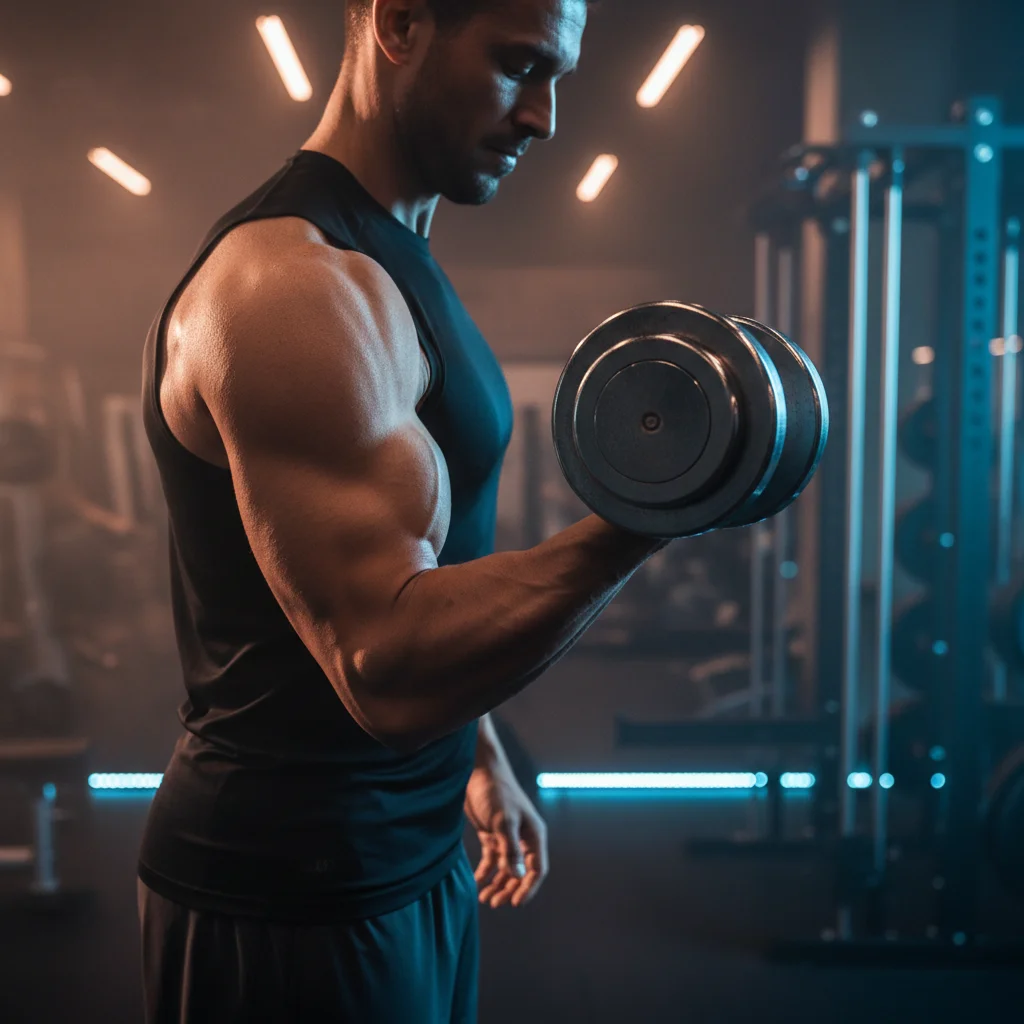
Your first bicep workout doesn't need to be complicated. You don't need seven exercises, fancy equipment, or a two-hour session. You need three or four movements, proper form, and enough intensity to make your arms actually work — without destroying them so badly you can't brush your teeth tomorrow.
This beginner bicep workout is built for people who are new to the gym, new to strength training, or new to training arms specifically. It takes about 20 minutes, uses basic equipment, and gives you everything you need to start building bigger biceps from day one.
Understanding Your Biceps First
Before you start curling, it helps to know what you're actually working.
The biceps brachii is a two-headed muscle on the front of your upper arm. The long head runs along the outer arm and gives the bicep its peaked shape when you flex. The short head sits on the inner side and adds width. Both heads work together during every curl, but different exercises emphasize one over the other.
You also have the brachialis underneath the biceps and the brachioradialis along your forearm. These assist during curling movements and contribute to overall arm thickness.
As a beginner, you don't need to worry about targeting specific heads yet. Your job right now is to learn proper form, build a base of strength, and get comfortable with bicep curls before adding complexity.
The Beginner Bicep Workout
Here's the full workout. Four exercises, three sets each. Rest 60-90 seconds between sets.
Exercise 1: Standing Dumbbell Curls
3 sets of 10-12 reps
The most fundamental bicep exercise. Stand with a dumbbell in each hand, palms facing forward, arms fully extended. Curl the weight up by flexing at the elbow — keep your upper arms pinned to your sides. Squeeze at the top, then lower under control for 2-3 seconds. Don't swing. If you have to use momentum, the weight is too heavy.
Starting weight: Most beginner men should start with 10-15 lb dumbbells. Most beginner women should start with 5-8 lbs. There's no shame in going light — form is everything when you're starting out.
Exercise 2: Hammer Curls
3 sets of 10-12 reps
Same movement as a regular curl, but with a neutral grip — palms facing each other instead of forward. This shifts more work to the brachialis and brachioradialis, building overall arm thickness. Hammer curls also tend to feel more natural on the wrist than regular curls, making them a great option for beginners who experience wrist discomfort.
Hold a dumbbell in each hand with palms facing your body. Curl up without rotating your wrists. Pause at the top, lower slowly.
Exercise 3: Barbell Curls or EZ Bar Curls
3 sets of 8-10 reps
A barbell curl lets you use both arms together, which usually means you can handle slightly more weight. If a straight barbell bothers your wrists, use an EZ curl bar — the angled grip is easier on the joints.
Stand with your feet shoulder-width apart, grip the bar with an underhand grip, and curl it up to chest height. Control the weight down — don't let it drop. Keep your elbows at your sides throughout.
Starting weight: An empty EZ bar (typically 15-25 lbs depending on the bar) is enough for most beginners.
Exercise 4: Concentration Curls
3 sets of 10-12 reps per arm
Sit on a bench, lean forward slightly, and brace your elbow against the inside of your thigh. Curl the dumbbell up with one arm at a time. This is pure isolation — there's nowhere for momentum to hide. Concentration curls force you to slow down and actually feel the bicep working, which builds mind-muscle connection that carries over to every other exercise.
Starting weight: 8-12 lbs for men, 5-8 lbs for women. Go lighter than you think — the isolation makes these surprisingly hard.
Coach's Note: Your first arm day should leave your biceps tired but not wrecked. If you can't straighten your arms the next morning, you did too much. Start with 3 sets per exercise and add a fourth set after 2-3 weeks when your body adapts. Beginners grow from less volume than you'd think.
Bicep Workout Tips for Beginners
Control every rep. The most common beginner mistake is swinging the weight up and letting it drop back down. That's using momentum, not your biceps. Two seconds up, pause at the top, two to three seconds down. Every rep should feel deliberate.
Use a weight you can actually control. If you can't do 10 reps with clean form, the weight is too heavy. Drop the ego. Nobody in the gym is watching you — and if they are, they respect good form more than heavy weights with terrible technique.
Don't overtrain your biceps. Your biceps are a small muscle group. They don't need or respond well to high volume, especially when you're new. This workout — 12 total sets — is plenty. Training biceps more than twice a week as a beginner is counterproductive. More isn't better. Enough is better.
Warm up first. Do 5 minutes of light cardio — walking, cycling, or rowing — to get blood flowing. Then do one light set of curls with very low weight before starting your working sets. Warming up reduces injury risk and improves performance.
Track your workouts. Write down the weight and reps for each exercise. Next session, try to do one more rep or add 2.5 lbs. This is called progressive overload — and it's the single most important principle for building strength and muscle size over time.
How to Add This Workout to Your Week
Option 1: Dedicated arm day. Do this bicep workout on its own day, and add tricep exercises after for a complete arm day. Once a week is enough for beginners.
Option 2: Back and bicep day. Pair this workout with back exercises — rows, pulldowns, or pull-ups. Your biceps already work during pulling movements, so this is an efficient way to train. Do your back work first, then finish with this bicep workout. This is essentially a pull day structure.
Option 3: Full body days. If you're doing full body workouts 3 times per week, pick one or two exercises from this list and add them at the end of each session. Rotate between them so you're hitting different curl variations across the week.
Frequency: 1-2 times per week for beginners. Your biceps also get worked during back exercises like rows and pulldowns, so direct bicep training twice a week on top of back work is plenty of stimulation.
When to Progress Beyond This Workout
This beginner bicep workout will take you far — probably 3-6 months before you need to change much. Here's how to know when you're ready to level up.
You can do all sets with the starting weight easily. When 12 reps feels light on every set, increase the weight by 2.5-5 lbs. If the heavier weight drops you to 8 reps, that's perfect — work back up to 12, then increase again.
You stop feeling challenged. When the workout feels routine and your arms aren't fatigued afterward, it's time to add volume (a fourth set per exercise) or introduce new exercises like incline dumbbell curls, cable curls, or preacher curls.
You've been consistent for 3+ months. If you've trained biceps consistently 1-2 times per week for three months, your body has adapted to the basics. That's when you start experimenting with different rep ranges, new exercises, and more advanced programming.
Frequently Asked Questions
How should a beginner train biceps?
Start with 3-4 basic exercises — standing dumbbell curls, hammer curls, barbell curls, and concentration curls. Do 3 sets of 10-12 reps per exercise with weight you can control. Focus on strict form, not heavy weight. Train biceps 1-2 times per week and increase weight gradually as you get stronger.
What weight should a beginner use for bicep curls?
Most beginner men should start with 10-15 lb dumbbells. Most beginner women should start with 5-8 lbs. The right weight is one where you can complete 10 reps with clean form but the last 2-3 reps feel genuinely challenging. If you're swinging or arching your back, go lighter.
How many bicep exercises should a beginner do?
Three to four exercises is plenty. Your biceps are a small muscle group and don't need a dozen exercises to grow. Quality of contraction matters more than variety at the beginner stage. Master the basics before adding more movements.
Can I train biceps every day?
No. Muscles grow during rest, not during training. Training biceps daily doesn't give them time to recover and rebuild. Once or twice a week with proper intensity is optimal for beginners. If your biceps are still sore from the last session, wait until the soreness is gone before training them again.
How long does it take to see bicep growth?
Many beginners notice visible changes in 6-8 weeks of consistent training with progressive overload and adequate nutrition. Strength gains come faster — you'll feel stronger within 2-3 weeks. Real size changes take longer because muscle growth is a slow process. Stay consistent and it happens.
Do I need a gym for bicep workouts?
No. A pair of adjustable dumbbells at home covers every exercise in this workout. A resistance band can also work for beginners who don't have access to weights. The movements are the same — the resistance source doesn't matter as much as the effort you put in.
The Bottom Line
Your first bicep workout should be simple, focused, and something you can actually stick with. Four exercises, three sets each, controlled reps, and a weight that challenges you without wrecking your form. Do this once or twice a week, add a little more weight when it gets easy, eat enough protein, and give it three months. That's all it takes to build a real foundation. The fancy stuff can come later — right now, just curl and be consistent.