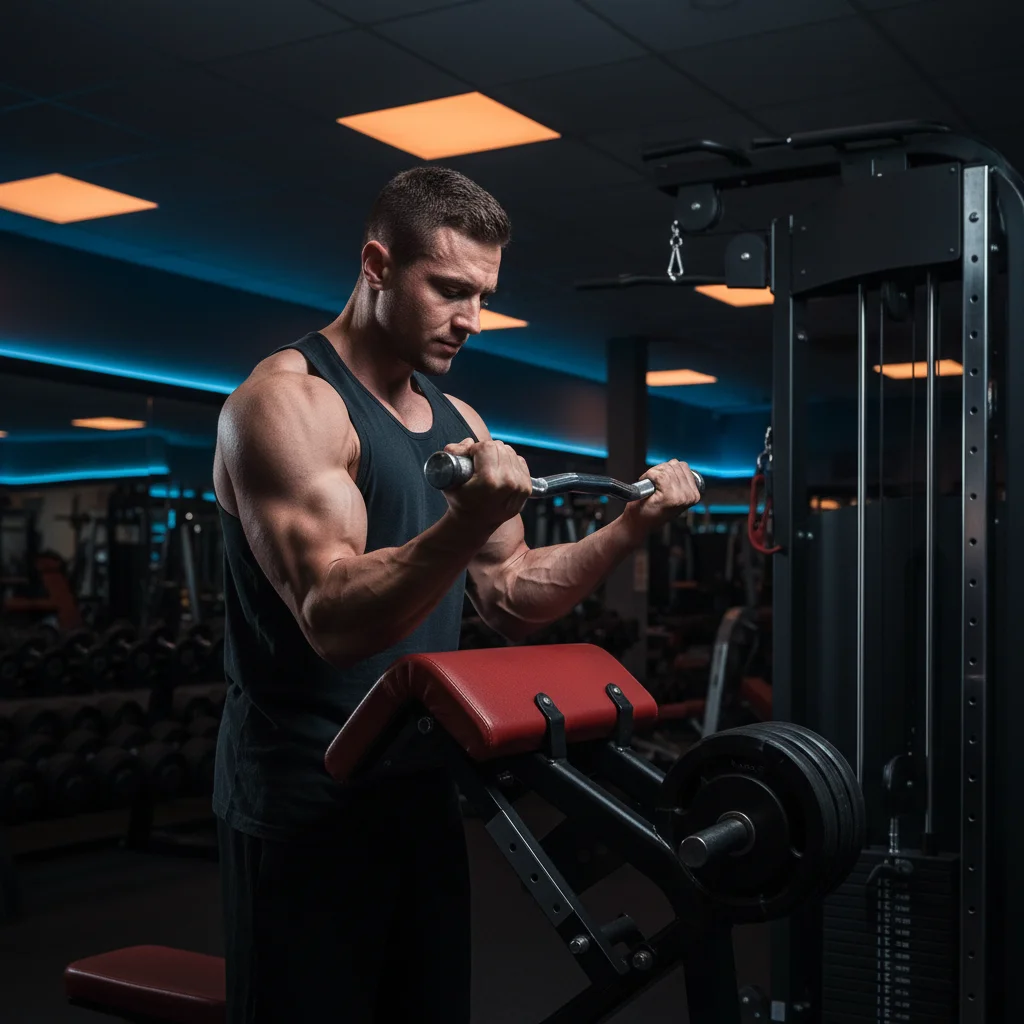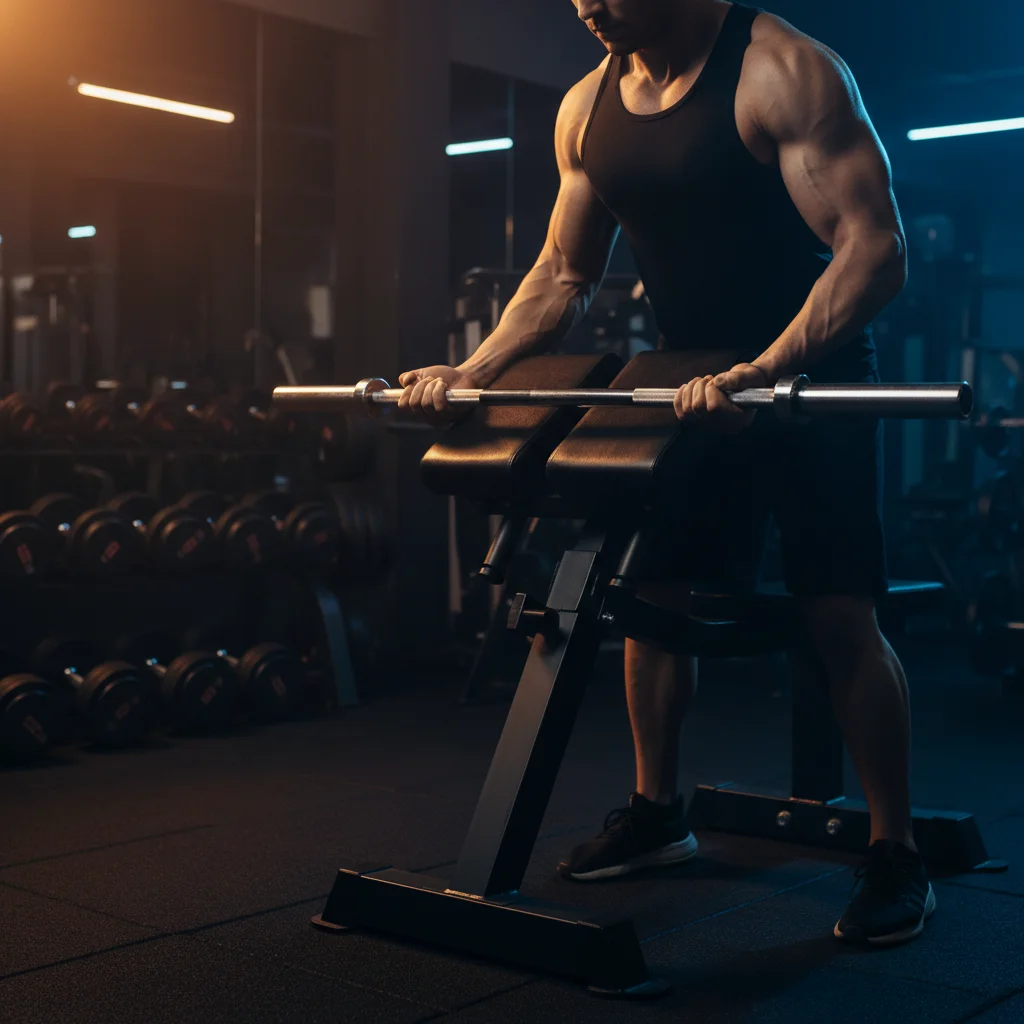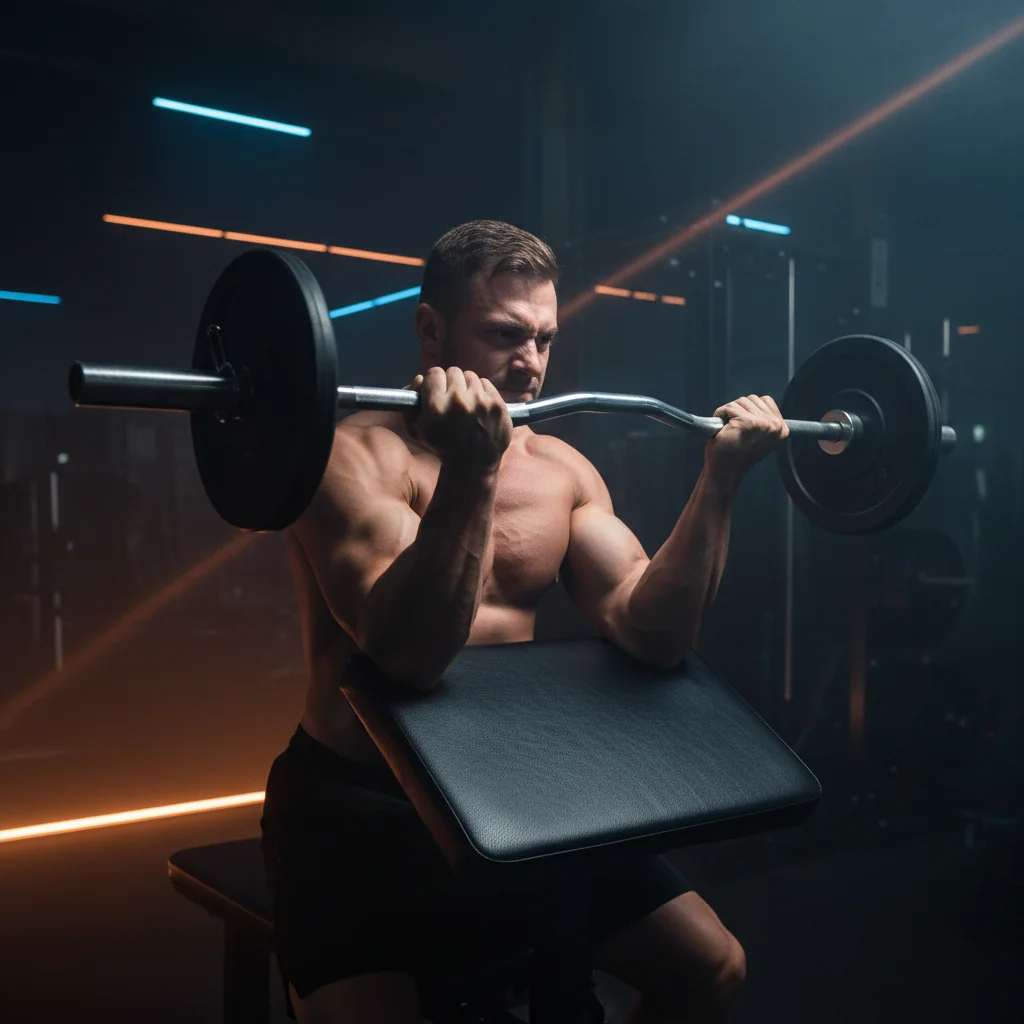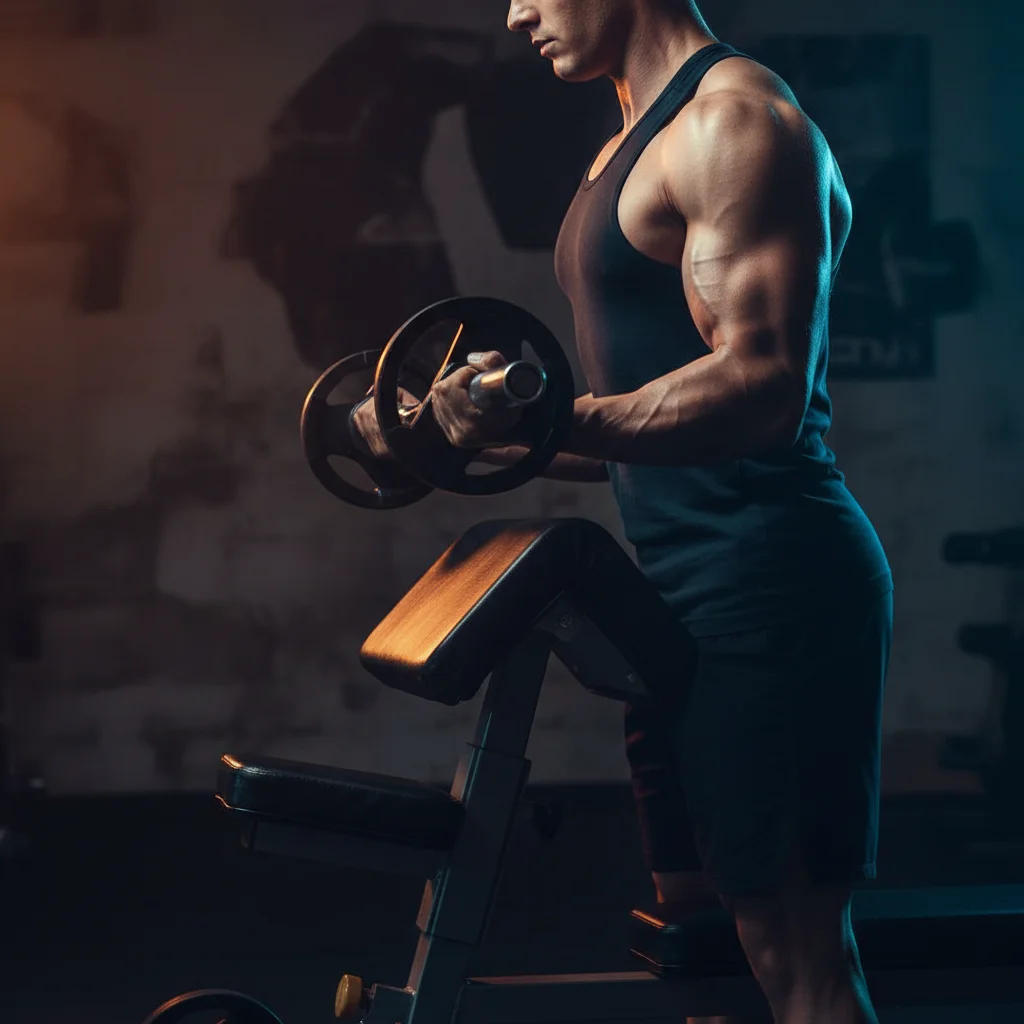
The standing preacher curl is what happens when you take the strict isolation of a seated preacher curl and add the natural body position of standing. Your upper arms lock against the pad, your elbows are fixed, and momentum becomes almost impossible — but unlike the seated version, you're on your feet, which many lifters find more comfortable and more natural.
It's one of the most underused preacher curl variations in most gyms. Whether you're using a dedicated standing preacher curl machine, a standard preacher bench while standing behind it, or an incline bench as a makeshift pad, this exercise delivers serious short head bicep work with zero cheating.
Here's how to set up, perform, and program the standing preacher curl for bigger biceps.
What Is a Standing Preacher Curl?
A standing preacher curl is any preacher curl performed while standing rather than sitting. Your upper arms rest against the angled pad of a preacher bench or machine, and you curl the weight upward while your body stays upright behind the pad.
The movement itself is basically the same as a seated preacher curl — the pad locks your arms in position, eliminates body English, and emphasizes the short head of the biceps. The only difference is your lower body position: standing instead of sitting.
Some gyms have dedicated standing preacher curl machines with built-in weight stacks. Others have adjustable preacher benches that work for both standing and sitting. And if your gym has neither, an incline bench set to about 45-60 degrees makes a solid substitute — drape your arms over the back of the incline and you've got a standing preacher station.
Muscles Worked
The standing preacher curl targets the same muscles as any preacher curl variation:
**Biceps brachii (primary).** Both heads work, but the short head does the heavy lifting. Because your arms are positioned in front of your body on the pad, the long head is in a shortened position and can't generate as much force. The short head picks up the slack — which is why preacher curls are the go-to exercise for building bicep width.
**Brachialis (secondary).** The brachialis muscle assists in every elbow flexion movement. Its contribution increases if you use a neutral or pronated grip on the preacher pad.
**Brachioradialis and forearm flexors (stabilizers).** Your forearms work to maintain your grip on the bar or dumbbell throughout the movement. The brachioradialis assists in elbow flexion, especially during the lower portion of the range of motion.
How to Do a Standing Preacher Curl With Proper Form
Step-by-Step Setup
**Step 1:** Adjust the preacher bench pad height so the top of the pad sits snugly in your armpits when you're standing behind it. If the pad is too low, you'll lean over it and use your shoulders. If it's too high, your elbows won't sit properly on the surface.
**Step 2:** Stand with your feet shoulder-width apart, chest pressed lightly against the top edge of the pad. Your upper arms should lie flat against the angled surface from armpit to elbow.
**Step 3:** Grip your dumbbell, EZ bar, or barbell with an underhand grip at roughly shoulder width. Let your arms extend down the pad — not fully locked out, but with a very slight bend at the elbow to protect the joint.
The Curl
Curl the weight upward by contracting your biceps. Your upper arms stay pressed against the pad throughout — they shouldn't lift off at any point. The only movement is at the elbow joint.
Curl until your forearms approach vertical. Don't bring the weight all the way to your chin — once your forearms pass vertical, tension on the biceps actually decreases. Stop just before that point where you feel the resistance drop off.
Lower the weight under strict control. This is where the standing preacher curl demands respect — the stretched position at the bottom is where the bicep tendon is most vulnerable. Take 3 seconds to lower and don't bounce out of the bottom.
Coach's Note: The most common mistake on preacher curls isn't the curl — it's the setup. If the pad isn't in your armpits, nothing else matters. Too low and you'll shrug your way through every rep. Too high and your elbows slide off the pad mid-set. Take 30 seconds to get the height right before your first rep. That's not wasted time — it's the difference between a productive set and a useless one.
Standing vs Seated Preacher Curl: Which Is Better?
Neither is objectively better — they target the same muscles through the same movement pattern. The differences are practical, not physiological.
**Standing advantages:** More natural body position for many lifters. Easier to adjust pad height without a seat to worry about. Allows you to use your legs to help position the weight at the start of the set (useful with heavier loads). You can also lean your torso slightly forward or back to adjust the difficulty curve.
**Seated advantages:** More stability. Less temptation to use your legs or hips to cheat. Some lifters find the seated position keeps them more honest because there's zero possibility of body English.
**The practical answer:** Use whichever your gym has and whichever feels more stable. If you have access to both, alternate between them across training blocks. The muscle stimulus is virtually identical — what matters is consistent effort and progressive overload, not whether your butt is on a seat.
Standing Preacher Curl Variations
**Standing dumbbell preacher curl.** Using a dumbbell instead of a barbell allows each arm to work independently and permits full wrist supination at the top. Grip the dumbbell with your palm facing up and curl against the pad. This is the best variation for addressing strength imbalances between arms.
**Standing EZ bar preacher curl.** The EZ bar's angled grip reduces wrist strain while providing a semi-supinated position. This is the most popular barbell option for preacher curls and the one you'll see in most gyms. The angles let you train heavier without your wrists paying for it.
**Standing barbell preacher curl.** A straight barbell forces full supination, which maximizes biceps brachii activation — particularly the short head. However, the fixed wrist position creates more rotational stress. Use this if your wrists handle it well; switch to the EZ bar if they don't.
**Standing reverse preacher curl.** Flip your grip to palms down (pronated). This shifts the exercise from a bicep builder to a brachioradialis and forearm exercise. Use very light weight — the combination of the preacher pad lockdown and the pronated grip makes this humblingly difficult.
**Standing incline bench preacher curl.** No preacher bench? Set an adjustable bench to about 45-60 degrees and stand behind it. Drape your arms over the top of the backrest and curl. The angle isn't identical to a dedicated preacher pad, but the arm-against-surface principle works the same way.
Benefits of Standing Preacher Curls
**Eliminates cheating.** With your arms locked against the pad, there's no swinging, no shoulder hiking, and no back involvement. Every rep is pure elbow flexion driven by the biceps. If you suspect your standing curls involve too much body English, the preacher pad is the reality check.
**Short head emphasis.** The arms-in-front position shifts more of the work toward the short head, building the inner bicep width that gives your arms that full, thick look from the front. This complements exercises like incline curls that emphasize the long head.
**Joint-friendly.** The pad stabilizes your upper arm and shoulder, reducing stress on both joints. For lifters with shoulder issues who find standing curls uncomfortable, preacher curls often feel much better because the shoulder is in a stable, supported position.
**Easy to learn.** The pad provides external feedback — if your form is wrong, you'll feel it immediately. The arms slip, the elbows drift, or the pad digs in wrong. This makes standing preacher curls an excellent exercise for beginners learning strict curl form.
How to Program Standing Preacher Curls
Standing preacher curls work best as a primary or secondary exercise on arm day or during the bicep portion of a pull day workout.
**As your main curl:** 3 sets x 8-10 reps with moderate weight. Focus on the squeeze at the top and a controlled 3-second eccentric.
**As a secondary exercise:** 3 sets x 10-12 reps after heavier free weight curls like barbell curls or hammer curls.
**Paired with a long head exercise:** Alternate sets of standing preacher curls (short head) with incline dumbbell curls (long head) for complete bicep coverage in two exercises. Three sets of each, 10-12 reps, 60 seconds rest between alternating sets.
Because of the tendon stress in the stretched position at the bottom, limit preacher curls to 1-2 sessions per week. Your elbows need recovery time, especially if you're using meaningful weight.
Common Mistakes to Avoid
**Pad too low.** If the pad isn't in your armpits, you'll shrug your shoulders to compensate. This recruits your traps and front delts — muscles that shouldn't be involved. Raise the pad until it catches right at the armpit crease.
**Fully locking out at the bottom.** Extending your arms completely straight at the bottom puts enormous stress on the distal bicep tendon. Always maintain a slight bend — about 10-15 degrees — to keep the tension on the muscle rather than the tendon.
**Using too much weight.** The preacher pad removes all momentum, which means you're significantly weaker on this exercise than on standing curls. Using your standing curl weight on the preacher bench is a recipe for strained tendons. Drop the weight by 20-30% when switching from standing to preacher curls.
**Lifting your elbows off the pad.** If your elbows rise during the curl, your front deltoid is taking over. Press your upper arms firmly into the pad throughout every rep. If you can't keep them down, the weight is too heavy.
Frequently Asked Questions
Are standing preacher curls good?
Yes — they're one of the most effective exercises for targeting the short head of the biceps with strict form. The pad eliminates cheating and forces the biceps to do all the work. They're particularly valuable for lifters who tend to swing during standing curls.
Is standing or seated preacher curl better?
Neither is inherently better — they work the same muscles through the same movement. Standing is more natural for some lifters and allows easier setup. Seated provides more stability and eliminates any lower body involvement. Use whichever feels more comfortable and lets you focus on the bicep contraction.
Are preacher curls harder than standing curls?
Yes, and that's by design. The pad removes all momentum and body English, which means the biceps handle 100% of the load. Most lifters use 20-30% less weight on preacher curls compared to standing curls. The lower weight doesn't mean less effective — it means more honest.
Can preacher curls cause elbow pain?
They can if you fully lock out at the bottom or use too much weight. The stretched position places significant stress on the distal bicep tendon. Maintain a slight elbow bend at the bottom, control the eccentric, and progress weight gradually. If you experience persistent elbow pain, reduce the weight and check your pad positioning — elbows too far over the edge of the pad increases tendon stress.
What We Recommend
Gymreapers Arm Blaster
If your gym doesn't have a preacher station, an arm blaster provides similar elbow-locked isolation that you can use with any bar or dumbbell.
REP Fitness AB-3000 Adjustable Bench
An adjustable bench set to 45-60 degrees works as a standing preacher station — drape your arms over the backrest.
The Bottom Line
The standing preacher curl is one of the most direct paths to bigger, wider biceps. The pad does what willpower often can't — it makes cheating physically impossible. Whether you use a dedicated machine, a preacher bench, or an incline bench flipped backward, the principle is the same: lock your arms against a surface, curl with control, and let the short head do what it was built to do. Set the pad at armpit height, resist the temptation to go heavy, and focus on the quality of each contraction. That's where the growth happens.