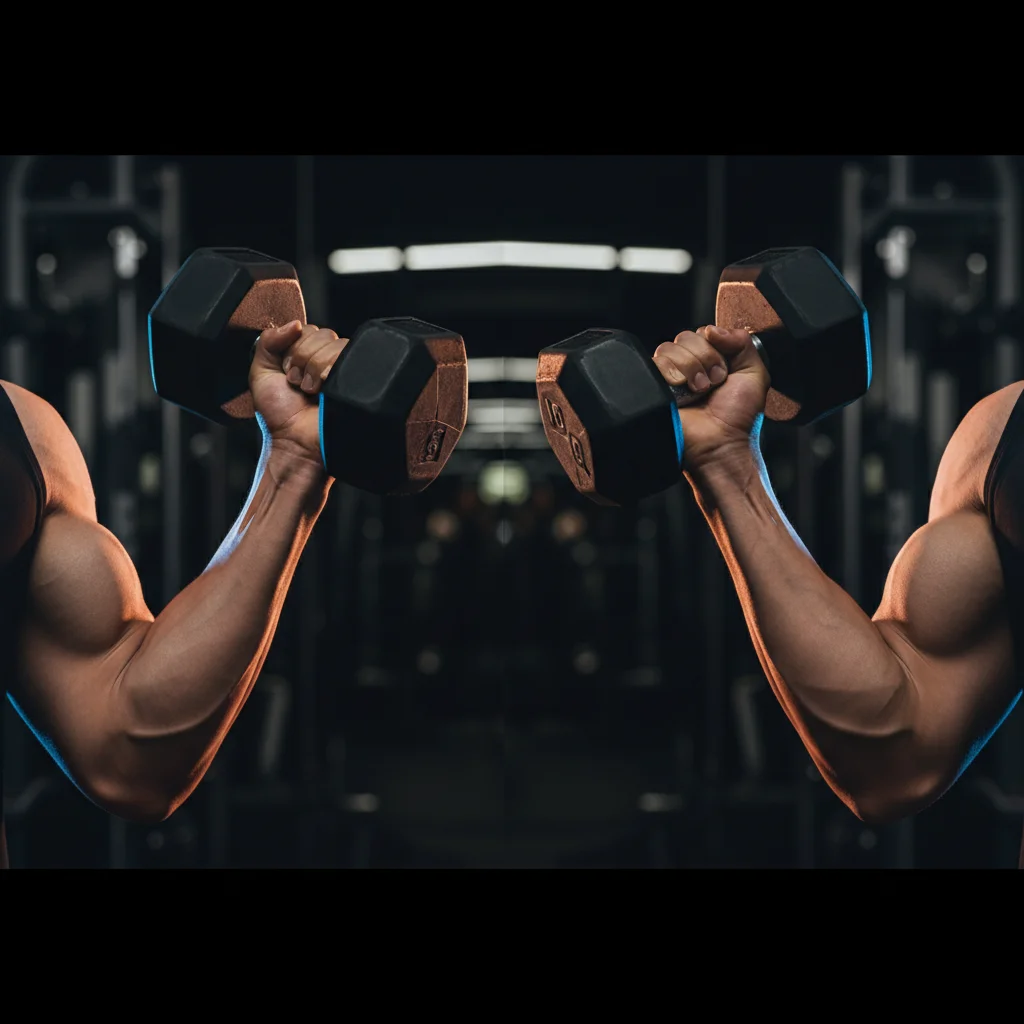
Dumbbell hammer curls are the most accessible and versatile way to perform the hammer curl. No specialty bars, no cable machines, no bench required — just a pair of dumbbells and proper technique. This guide covers every practical detail you need to get the most out of them.
The Standard Dumbbell Hammer Curl
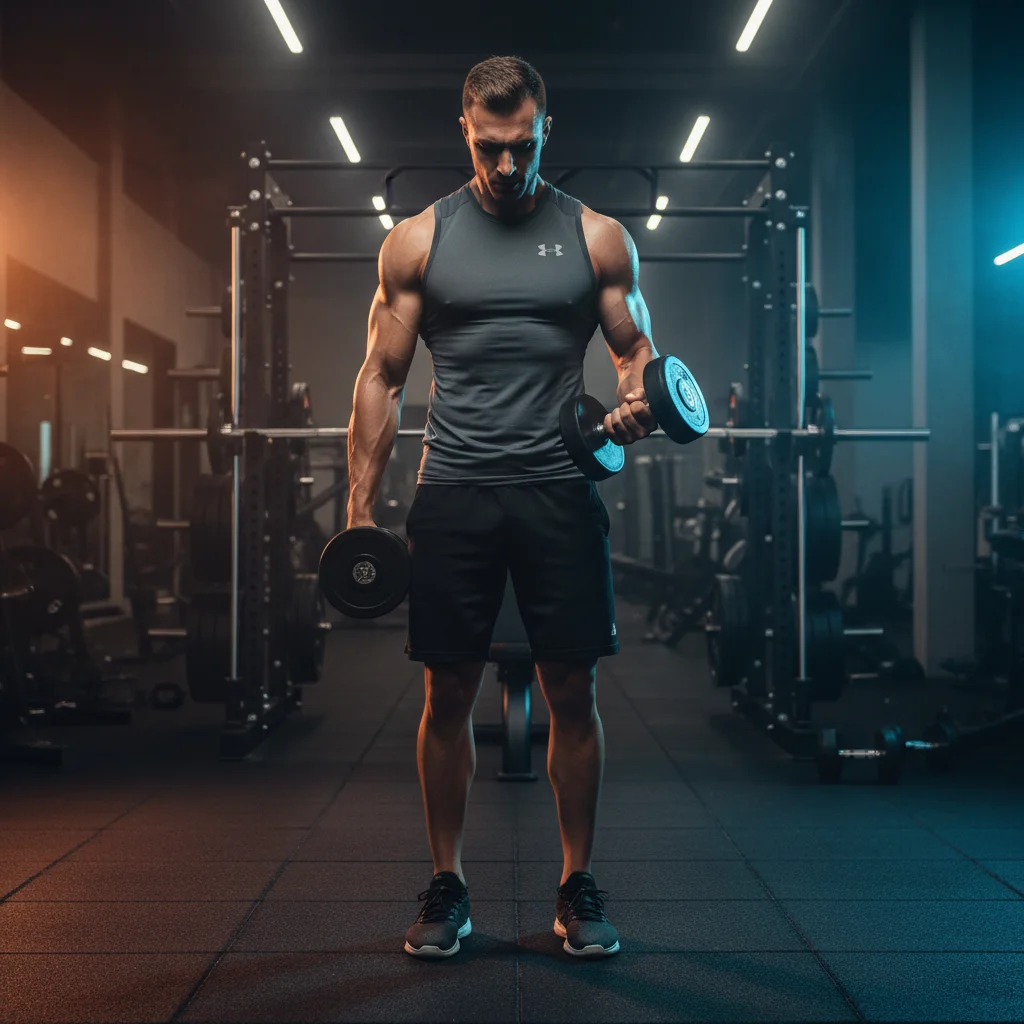
Stand with your feet shoulder-width apart, a dumbbell in each hand at your sides. Your palms face your thighs — this neutral grip is what defines the hammer curl. Unlike a standard bicep curl where you'd rotate your palms up, your palms stay facing inward throughout the entire rep.
Curl both dumbbells up simultaneously, bending only at the elbows. Your upper arms stay locked at your sides — no forward drift, no swinging. At the top, your thumbs should be near your shoulders with palms still facing each other.
Squeeze briefly, then lower under control for 2-3 seconds. Don't let the dumbbells swing at the bottom — come to a controlled stop before starting the next rep.
Alternating vs Simultaneous: Which Is Better?
Simultaneous (both arms at once) keeps constant tension on both arms and finishes the set faster. It's more metabolically demanding because both sides are working continuously. However, it's harder to maintain strict form with both dumbbells moving at once, especially as you fatigue.
Alternating (one arm at a time) lets you focus on each arm individually and typically allows for slightly better form. You can watch each bicep and brachialis contract, improving the mind-muscle connection. The downside is that each arm gets brief rest periods while the other works, slightly reducing metabolic stress.
For most people, alternating is the better default choice. The improved form quality outweighs the minor difference in metabolic stress. Switch to simultaneous when you're short on time or want to increase the cardiovascular demand.
Cross-Body Hammer Curls
Instead of curling straight up, curl the dumbbell across your body toward the opposite shoulder. This variation shifts more emphasis to the brachialis and the long head of the biceps.
The cross-body path changes the angle of pull on the elbow flexors. You'll feel the contraction deeper in the upper arm — more in the area between your bicep and tricep on the outer portion of the arm. This is the brachialis working harder.
Always alternate arms on cross-body hammer curls. Doing both simultaneously is awkward and limits range of motion since the dumbbells would collide.
Cross-Body Path: The dumbbell should travel diagonally across your torso, ending near the opposite pec. Don't bring it all the way to the opposite shoulder — that's too far and involves unnecessary shoulder flexion. Aim for a path that ends in front of your chest, roughly at nipple height.
Seated Dumbbell Hammer Curls
Sit on a bench (flat or with back support) and perform hammer curls from the seated position. This eliminates all lower body momentum and any tendency to lean back.
You'll use about 10-15% less weight seated, but the biceps, brachialis, and brachioradialis are doing every bit of the work. If you suspect you've been swinging on standing hammer curls, seated variations are the honest test.
The seated position works particularly well for alternating hammer curls, where you can brace your non-working arm against the bench for extra stability.
How Heavy Should You Go?
Hammer curls allow slightly more weight than standard dumbbell curls — typically 5-10% more. If you curl 25-pound dumbbells with a supinated grip, you might handle 27-30 pounds on hammer curls.
However, heavier isn't always better. The brachialis responds well to moderate weight with controlled form. Three sets of 10-12 reps with strict form will build more arm size than 3 sets of 6 with swinging and momentum.
For forearm-focused development, drop the weight further and do sets of 15-20 with a slow 3-second eccentric. The brachioradialis burn from this approach is significant.
Programming Recommendations
Dumbbell hammer curls fit best as a second or third exercise on arm day. After your primary bicep exercise — barbell curls, incline curls, or preacher curls — hammer curls target the muscles those exercises underemphasize.
For hypertrophy: 3 sets of 10-12 reps, alternating, with 60-90 seconds rest between sets.
For strength: 4 sets of 6-8 reps, simultaneous, with 2 minutes rest. Use strict form and add weight progressively.
For forearm emphasis: 2-3 sets of 15-20 reps with slow eccentrics. Light weight, maximum control.
Training frequency: 1-2 times per week is sufficient. If you're doing other brachialis work like reverse curls or rope cable curls, once per week is plenty.
The Bottom Line
Dumbbell hammer curls are the simplest way to build the brachialis and brachioradialis — the muscles that create arm thickness visible from every angle. Master the standard version first, then experiment with cross-body and seated variations to keep the stimulus fresh. No gym? No problem — a pair of dumbbells at home is all you need.