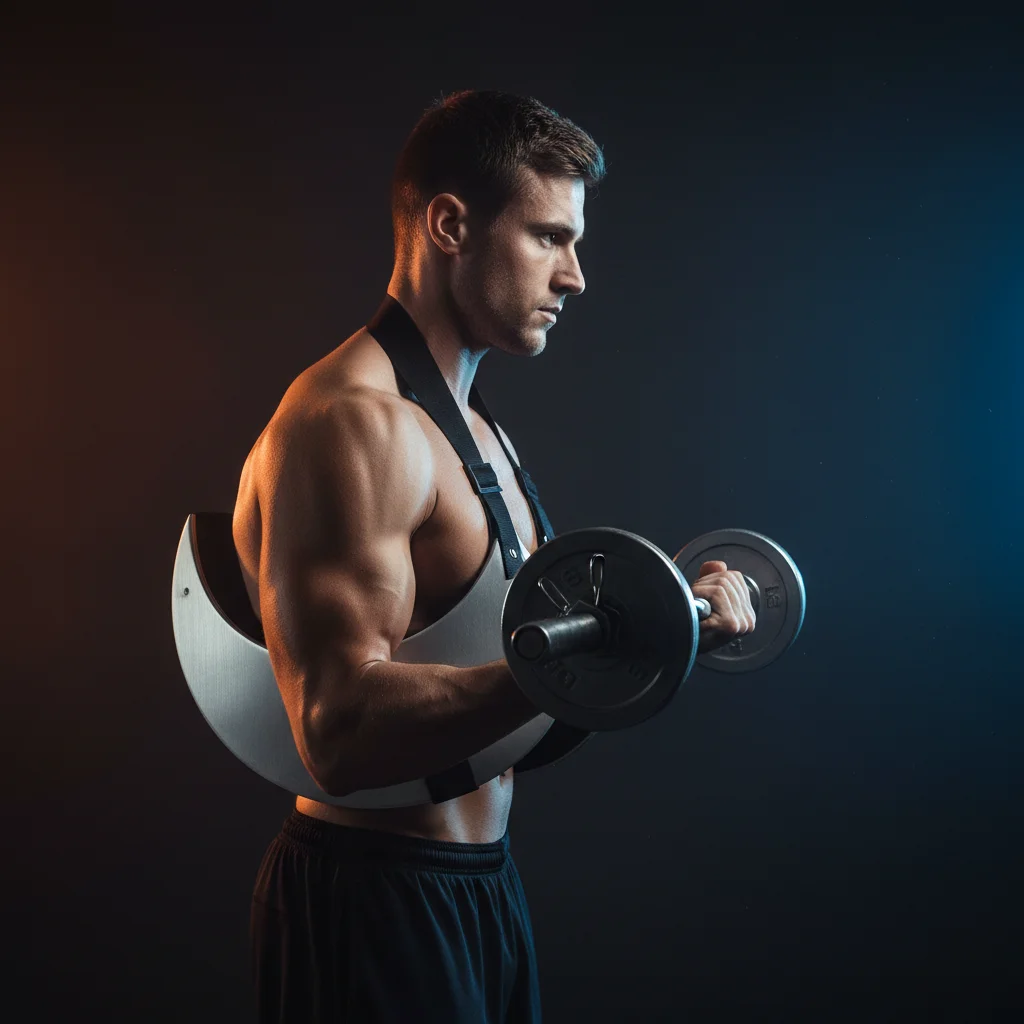
The arm blaster is one of those pieces of gym equipment that looks like it hasn't changed since Arnold was using one in the 1970s — because it hasn't. It's a curved aluminum plate that hangs from your neck and locks your elbows against your torso while you curl. Simple. Almost primitive. And surprisingly effective.
But is it worth the money? Does it actually build bigger biceps? Or is it just a nostalgic accessory that looks cool on Instagram and collects dust in your gym bag?
After using arm blasters across hundreds of workouts and watching lifters at every level try them, here's an honest breakdown of what they do, what they don't do, and whether you should buy one.
What Is an Arm Blaster?
An arm blaster is a curved metal plate — usually aluminum — that hangs from an adjustable nylon strap around your neck. The plate sits against your torso, and when you curl, your elbows press into the plate. This locks your upper arms in position and eliminates the swinging, shoulder involvement, and body English that most lifters unconsciously rely on during standing curls.
Think of it as a portable, wearable preacher curl station. The preacher bench locks your arms against a pad. The arm blaster locks your arms against your body. The goal is the same: force the biceps to do all the work by removing every possible cheat.
Old-school bodybuilders were using these before half of today's accessory companies existed. The design hasn't changed because it didn't need to. Curved aluminum, adjustable strap, neck pad. That's the whole product.
How Does the Arm Blaster Work?
The arm blaster works by solving a specific problem: elbow drift.
During a standing barbell curl or dumbbell curl, your elbows naturally drift forward and backward. When they drift forward, your front deltoids start helping. When they drift backward, you're using momentum from your back. Either way, your biceps are sharing the load with muscles that shouldn't be involved.
The arm blaster's curved plate creates a physical barrier. Your elbows press against it and can't move. The only motion that's possible is elbow flexion — bending the arm. That's pure bicep work.
You'll know this in your first set. When you strap on an arm blaster for the first time and try to curl your normal weight, you'll immediately discover two things: the weight feels heavier, and your biceps burn faster. That's not because the arm blaster adds resistance — it's because your biceps are finally doing 100% of the work instead of 70-80%.
Does the Arm Blaster Actually Build Bigger Biceps?
Yes — but with an important caveat.
The arm blaster doesn't build muscle that strict curls can't. It's not a magic tool. What it does is enforce the strict form that most lifters lack the discipline to maintain on their own. If you already curl with perfect form — elbows pinned, no swing, no shoulder involvement — an arm blaster won't change much for you.
But most people don't curl with perfect form. Most people swing. Most people use momentum on the last 2-3 reps. Most people let their elbows drift without realizing it. For those lifters — which is the majority — the arm blaster forces better isolation, which means better muscle activation, which over time means better growth.
The honest answer: an arm blaster is a form enforcement tool. It doesn't replace hard work or progressive overload. But it makes sure the hard work actually reaches your biceps instead of being distributed across your shoulders, back, and ego.
Coach's Note: The arm blaster will humble you. Whatever you normally curl for 10 reps, expect to drop 15-20% on the arm blaster. That gap between your "arm blaster weight" and your "standing curl weight" tells you exactly how much momentum you've been using. Close that gap over time, and your arms will grow — with or without the blaster.
Arm Blaster vs Preacher Curl: What's the Difference?
Both tools serve the same purpose — strict bicep isolation — but they do it differently.
**The preacher curl** uses an angled pad that your arms drape over. Your upper arms are fixed against the surface, and the angle puts the biceps in a lengthened position at the bottom of the movement. This emphasizes the short head and creates a strong stretch under load. The downside: you need a dedicated bench, and the fixed angle means you're limited to one arm position.
**The arm blaster** locks your elbows against your torso using a chest plate. Your arms stay at your sides in a more natural position — similar to a standing curl but without the ability to cheat. It doesn't create the same lengthened stretch as a preacher bench, but it allows more natural wrist rotation and works well with barbells, dumbbells, and EZ bars.
**Which is better?** Neither replaces the other. The preacher curl targets the short head through a stretched position. The arm blaster enforces strict form in a neutral arm position. Ideally, you'd use both across your training week. If you can only pick one, the arm blaster is more versatile — it works with any bar or dumbbell and fits in a gym bag.
How to Use the Arm Blaster Properly
Setup
**Step 1:** Adjust the strap so the plate sits against your upper abdomen — roughly at the bottom of your ribcage. If it's too high (chest level), your elbows won't sit properly. If it's too low (belly button), the plate won't catch your elbows during the curl.
**Step 2:** Let the plate rest flat against your body. Your elbows should press into the curved edges of the plate naturally when your arms hang at your sides.
**Step 3:** Grip your barbell, EZ bar, or dumbbells. Start with lighter weight than your normal curl — at least 15-20% lighter for your first session.
The Curl
Press your elbows firmly into the plate. Curl the weight up by bending at the elbows only. Your upper arms shouldn't move — no forward drift, no backward pull. The plate enforces this, but you should actively focus on keeping your elbows pinned.
Squeeze at the top. Lower under control — at least 2-3 seconds on the way down. The arm blaster makes the eccentric phase particularly effective because you can't use momentum to cushion the descent.
Common Arm Blaster Mistakes
**Neck pad digging in.** If the strap digs into your neck, either the strap is too tight or the pad is too thin. A good arm blaster has a thick, cushioned neck pad. Cheap ones have a thin strip that becomes painful after 2 sets.
**Plate too high or too low.** The plate should sit at ribcage level. Too high and you're curling against your chest. Too low and your elbows hang below the plate edge — defeating the purpose entirely.
**Going too heavy.** The arm blaster removes every compensation pattern. Your normal curl weight will be too heavy. Start light, focus on the contraction, and build back up over time.
**Leaning backward.** Some lifters lean back to shift the angle and make the curl easier. This puts stress on the lower back and defeats the purpose of the arm blaster. Stay upright.
What Exercises Can You Do With an Arm Blaster?
The arm blaster works with any standing curl variation:
**Barbell curls.** The classic pairing. The arm blaster turns a regular barbell curl into one of the strictest bicep exercises you can do. Use a straight bar or an EZ curl bar.
**Dumbbell curls.** Standing dumbbell curls with the arm blaster allow full wrist supination while maintaining strict elbow position. Alternate arms or curl both simultaneously.
**Hammer curls.** Hammer curls with the arm blaster target the brachialis and brachioradialis with the same strict form enforcement. The neutral grip presses differently against the plate — you may need to adjust the strap slightly.
**Reverse curls.** Reverse curls on the arm blaster are brutally humbling. The pronated grip combined with locked elbows means the brachioradialis handles almost everything. Use very light weight.
**Tricep work?** Some arm blasters are marketed for triceps. In practice, the plate gets in the way during most tricep movements. Stick to curls — that's what arm blasters are actually designed for.
Arm Blaster Workout
Here's a complete arm blaster session you can bolt onto any pull day or arm day:
**1. Arm Blaster EZ Bar Curl** — 3 sets x 8-10 reps
**2. Arm Blaster Hammer Curl** — 3 sets x 10-12 reps
**3. Arm Blaster Reverse Curl** — 2 sets x 12-15 reps
Total: 8 sets. That's enough to completely fry your biceps, brachialis, and forearms with strict isolation. Rest 60-90 seconds between sets. The arm blaster makes every set harder than it looks — don't add volume until you're sure you can handle it.
3 Disadvantages of Arm Blasters
No piece of equipment is perfect. Here's what arm blasters don't do well:
**Neck discomfort.** The arm blaster hangs from your neck. With heavier weights, the downward pull increases. Even with a good neck pad, this can become uncomfortable after several sets — especially for lifters with existing neck issues. If neck strain is a concern, a preacher bench or concentration curls provide similar isolation without the neck load.
**Limited to standing curls.** You can't use an arm blaster for seated curls, incline curls, or spider curls. It's strictly a standing curl accessory. If your bicep program relies heavily on bench-based curl variations, the arm blaster supplements your training rather than replacing any exercise.
**Doesn't replace progressive overload.** Some lifters buy an arm blaster expecting a transformation. The arm blaster improves form — it doesn't replace the need to gradually increase weight, volume, and effort over time. It's a tool, not a shortcut.
Who Should (and Shouldn't) Buy an Arm Blaster
**Buy one if:**
You swing during curls and can't seem to stop. You train at home without a preacher bench. You want a portable isolation tool that fits in a gym bag. You're an intermediate lifter who's plateaued on arm growth and suspects form is the issue.
**Skip it if:**
You already curl with genuinely strict form. You have neck issues that would be aggravated by a strap under load. You only do seated or bench-based curl variations. You're a beginner who'd benefit more from just learning proper curl mechanics first.
What We Recommend
Gymreapers Arm Blaster
Heavy-gauge aluminum with a thick neck pad that doesn't dig in after 4 sets. Fits arms from skinny to 20+ inches without adjustment. Contoured edges that actually match where your elbows naturally sit. The one most lifters keep after trying two or three cheaper options first.
**What to look for in an arm blaster:** Thick aluminum (not thin sheet metal that bends under load). A neck pad with real cushioning — not a thin nylon strip. An adjustable strap with a sturdy buckle that won't slip mid-set. Contoured edges that match the curve of your body. Skip anything under $20 — the neck pads are almost always too thin, and the aluminum flexes.
Frequently Asked Questions
Do arm blasters actually work?
Yes. They enforce strict curl form by locking your elbows against a plate, which eliminates momentum, shoulder involvement, and body English. This forces the biceps to handle the full load. You won't curl as much weight, but the weight you do curl goes directly to the target muscles.
Is the arm blaster better than the preacher curl?
They're different tools for the same goal. The preacher curl stretches the biceps and emphasizes the short head through an angled pad. The arm blaster enforces strict form in a standing position and works with any curl variation. Use both if possible. If you can only pick one, the arm blaster is more portable and versatile.
Are arm blasters safe?
Yes — but two things matter. First, the neck strap puts load on your cervical spine — start light and stop if you experience neck pain. Second, the strict form can expose weak tendons to loads they aren't used to handling without momentum assistance. Start with lighter weight than your normal curl and progress gradually.
Where should an arm blaster sit?
The plate should sit at your upper abdomen, roughly at the bottom of your ribcage. Your elbows should rest naturally against the curved edges when your arms hang at your sides. Too high (chest level) and your elbows won't engage the plate. Too low (belly button) and the plate doesn't catch your elbows during the curl.
Can you use an arm blaster for triceps?
Technically yes, but practically it's awkward. The plate gets in the way of most tricep movements. Some lifters use it for overhead extensions by flipping the position, but this isn't what the tool was designed for. For tricep isolation, a cable machine or skull crushers are far more effective.
The Bottom Line
The arm blaster is one of the simplest and most effective bicep accessories you can own. It doesn't add resistance, change the exercise mechanics, or require a learning curve. It just locks your elbows in place and forces your biceps to do honest work. If you swing during curls, the arm blaster will fix that. If your biceps aren't growing despite curling regularly, the arm blaster might reveal that your form — not your effort — is the problem. It's not essential equipment. But for the price of a couple of protein shakes, it's one of the best investments you can make in your arm training.