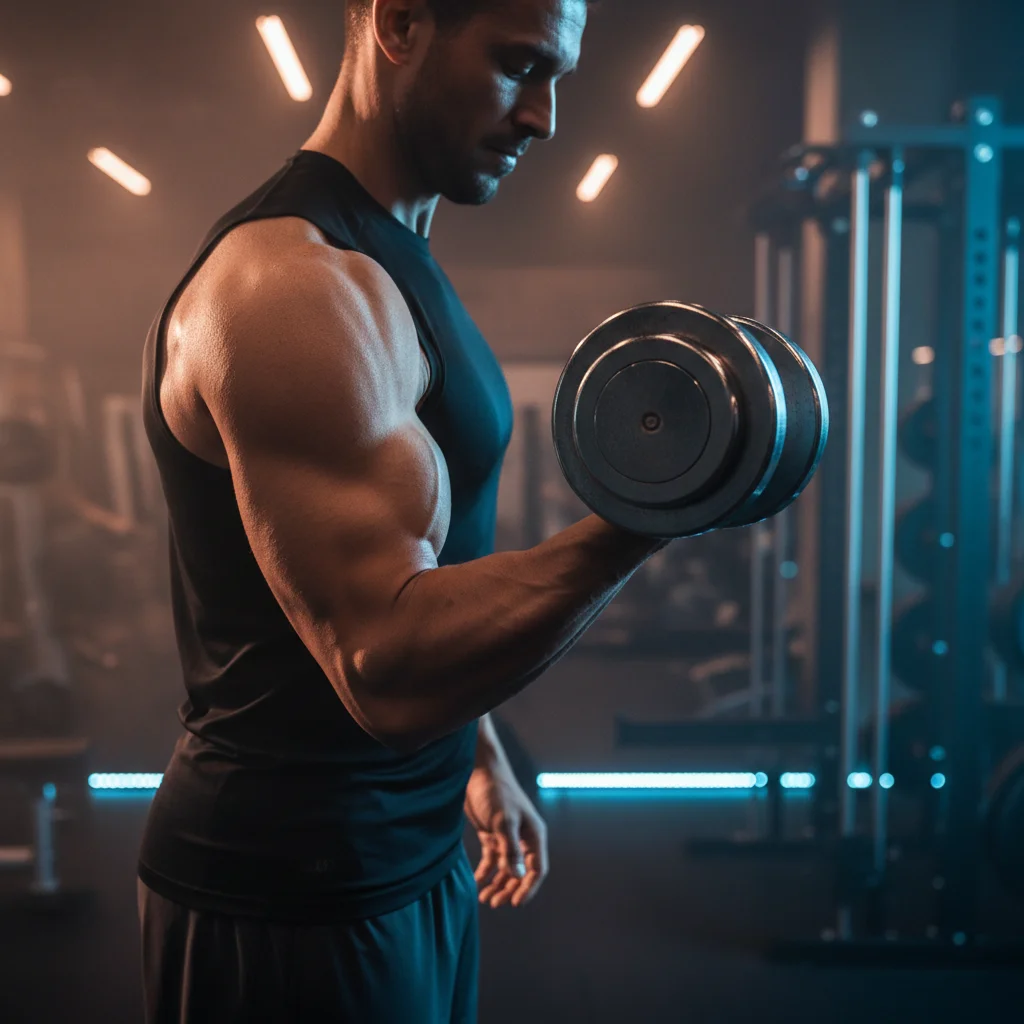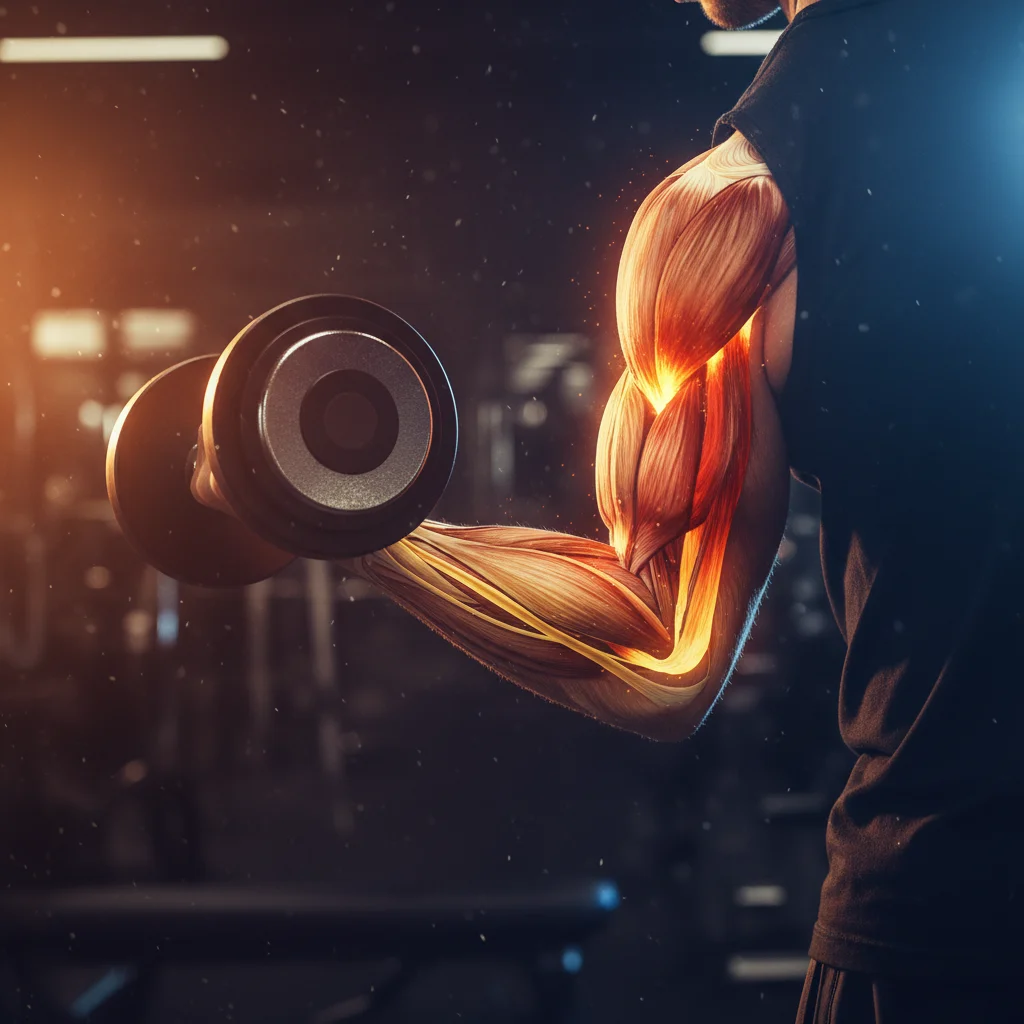
The bicep curl is the most recognizable exercise in any gym. Pick up a weight, bend your elbow, lower it back down. Simple. But when someone asks "what does bicep curls work?" the answer is more interesting than just "the biceps."
A single bicep curl activates muscles across your entire upper arm and forearm — some as primary movers, others as stabilizers, and a few that only kick in depending on which curl variation you choose. Understanding what's actually working during every rep helps you pick the right exercises, fix weak points, and build arms that are strong from every angle.
Here's the complete breakdown.
The Primary Muscles Bicep Curls Work
Biceps Brachii — The Main Target
The biceps brachii is the two-headed muscle on the front of your upper arm, and it's the primary mover in every bicep curl variation. Its job is twofold: it flexes the elbow (bends your arm) and supinates the forearm (rotates your palm from facing down to facing up).
The **long head** sits on the outer portion of your arm. It's the head responsible for the bicep peak — that high, round shape you see when flexing from the side. Exercises that position your arms behind your body, like incline curls, emphasize the long head by stretching it at the start of each rep.
The **short head** sits on the inner portion. It contributes to arm width when viewed from the front. Exercises that position your arms in front of your body, like preacher curls, emphasize the short head because the long head is shortened and less mechanically active.
Both heads work together during a standard standing bicep curl. You don't need to obsess over isolating one head — but knowing the difference helps you build a complete arm.
Brachialis — The Hidden Thickness Builder
The brachialis muscle sits underneath the biceps brachii. It's a pure elbow flexor — it bends your arm regardless of whether your palm is up, down, or neutral. When developed, it literally pushes the bicep up from below, making your entire upper arm look thicker and more three-dimensional.
The brachialis works during every bicep curl, but its contribution increases significantly when you use a neutral grip (palms facing each other) or a pronated grip (palms facing down). That's why hammer curls and reverse curls are the go-to exercises for brachialis development — they put the biceps brachii at a mechanical disadvantage and force the brachialis to handle more of the load.
Brachioradialis — The Forearm Builder
The brachioradialis is the thick muscle running along the thumb side of your forearm, from just above the elbow to near the wrist. It assists in elbow flexion during every curl, but it works hardest when your forearm is in a neutral or pronated position.
During a standard supinated bicep curl (palms up), the brachioradialis contributes modestly. Flip to a hammer curl or reverse curl, and it becomes one of the primary movers. This is why lifters who only do palms-up curls often have underdeveloped forearms — the brachioradialis never gets enough direct work.
The Secondary and Stabilizer Muscles
Bicep curls aren't purely a bicep exercise. Several other muscle groups work behind the scenes to make each rep happen — and most lifters never think about them until one becomes the weak link.
**Anterior deltoid (front shoulder).** Your front deltoid stabilizes the shoulder joint during every curl. It's not supposed to be a primary mover — if your shoulder is doing significant work, you're swinging the weight or lifting your elbows too far forward. But it's always engaged isometrically, keeping your upper arm in position.
**Forearm flexors.** The muscles on the palm side of your forearm contract to maintain your grip on the dumbbell, barbell, or handle. The heavier you curl, the harder your forearm flexors work. This is why heavy barbell curls double as a grip strength exercise, even without any wrist movement.
**Core and spinal stabilizers.** Standing curls require your core to brace against the weight pulling your torso forward. This isn't enough to build a six-pack, but it is enough that people with weak cores tend to lean back during curls — which is both a form breakdown and a sign that core work is needed.
**Scapular stabilizers and rotator cuff.** Your scapula (shoulder blade) must remain stable and retracted during curls, and the rotator cuff muscles work to keep the shoulder joint secure. These aren't "working" in any growth-producing way — but they're active, and poor shoulder stability can actually limit how much weight you can curl effectively.
**Wrist extensors.** The muscles on the back of your forearm work isometrically to keep your wrist from collapsing forward under the weight. This is more pronounced with heavier weights and during barbell curls where the wrist angle is fixed.
How Curl Variations Change Which Muscles Work
Not all bicep curls are created equal. The muscles worked shift based on three variables: grip position, arm position relative to your body, and the type of resistance.
**Standing dumbbell curl (supinated grip).** Works both heads of the biceps brachii evenly. The supinated palm position maximizes bicep activation. Brachialis and brachioradialis assist but aren't primary. This is the baseline — the exercise every other curl is compared against.
**Hammer curl (neutral grip).** Shifts significant work from the biceps brachii to the brachialis and brachioradialis. Builds arm thickness rather than peak. You can typically handle equal or slightly more weight than a supinated curl.
**Reverse curl (pronated grip).** The brachioradialis becomes the primary mover, with the brachialis assisting. The biceps brachii contributes the least in this position. Best forearm builder of any curl variation. Expect to use about 50-60% of your standard curl weight.
**Preacher curl (arms in front of body).** Emphasizes the short head because the long head is in a shortened position. Eliminates momentum completely. The brachialis also works hard due to the locked-arm position.
**Incline curl (arms behind body).** Emphasizes the long head by stretching it at the bottom of each rep. The stretched position creates a strong growth stimulus. You'll use less weight, but the muscle works through a greater range of motion.
**Concentration curl (elbow braced).** Maximizes bicep activation by removing all compensatory movement. In EMG studies, it tends to rank among the highest for biceps brachii activation. Primarily targets whichever head is in the strongest mechanical position based on your arm angle.
**Cable curl (constant tension).** Works the same muscles as free weight curls but maintains tension throughout the entire range of motion — including the top and bottom where dumbbells and barbells lose resistance due to gravity.
Benefits of Bicep Curls
**Functional strength for daily life.** Every time you pick up a grocery bag, lift a child, carry a suitcase, or pull open a heavy door, your elbow flexors are doing the work. Stronger biceps, brachialis, and brachioradialis make all of these movements easier. Curls build the strength needed to make everything from pull-ups and rows to picking up a bag of groceries feel effortless.
**Arm aesthetics and muscle growth.** Bicep curls are the most direct path to bigger arms. Compound exercises like rows and pull-ups train the biceps as secondary movers, but they don't provide the focused volume that isolation curls deliver. If arm size is a goal, direct bicep curl work is essential — compounds alone typically aren't enough for muscle hypertrophy in the arms.
**Injury prevention.** Strong elbow flexors help stabilize the elbow joint and protect the bicep tendon during heavy pulling movements. Lifters who skip direct arm work and rely solely on compounds sometimes develop elbow tendon issues because their tendons are under-conditioned relative to the loads their back can handle.
**Strength carryover.** Stronger biceps improve performance on compound pulling exercises — chin-ups, rows, and pull-ups all benefit from stronger elbow flexors. The bicep curl builds the foundation that makes those bigger movements possible. In any strength training program, progressive overload on curls (gradually increasing weight or reps) translates directly to pulling power.
How to Do Bicep Curls With Proper Form
Stand with your feet shoulder-width apart, a dumbbell in each hand at your sides with palms facing forward. Brace your core lightly.
Curl the weight upward by bending at the elbow. Keep your upper arms pinned to your sides — they shouldn't drift forward until the very top of the movement. Actively supinate as you curl, turning your pinky toward the ceiling to maximize biceps brachii muscle engagement.
Squeeze hard at the top for a full second. Then lower the weight under control — at least 2 seconds on the eccentric. Let your arms fully extend at the bottom before starting the next rep. Full range of motion, every rep.
Coach's Note: If you can curl a weight 15 times with perfect form, it's too light. If you can't do 6 reps without swinging, it's too heavy. The sweet spot for muscle growth is a weight that challenges you between 8-12 reps where the last two feel genuinely hard — not "I could do more" hard, but "I'm not sure I'll get this one" hard.
Common Bicep Curl Mistakes
**Using momentum instead of muscle.** Swinging the weight up with your hips and back is the most common mistake. It turns a bicep exercise into a full-body heave where the biceps do maybe half the work. If you need momentum, lower the weight.
**Cutting range of motion.** Starting with bent elbows or stopping before full contraction robs you of the stretch at the bottom and the squeeze at the top — the two most productive portions of the rep.
**Going too fast.** Speed kills gains on curls. The eccentric (lowering) phase should take at least 2 seconds. Dropping the weight quickly wastes the portion of the exercise where the most productive muscle damage occurs.
**Lifting the elbows.** If your elbows drift forward throughout the rep, your front deltoid is taking over. Pin your elbows until the last 10-15 degrees of the curl where a slight forward movement is natural.
**Ignoring grip variations.** Doing only supinated curls neglects the brachialis and brachioradialis. Include hammer curls or reverse curls in your routine to build complete arms, not just a big bicep peak with skinny forearms underneath.
Biceps Curl Variations Worth Adding
If you've been doing the same curl for months, try rotating in these variations to target different muscles and different points in the range of motion:
**For long head emphasis:** incline dumbbell curls, Bayesian curls, drag curls
**For short head emphasis:** preacher curls, spider curls, wide-grip EZ bar curls
**For brachialis emphasis:** hammer curls, cross-body hammer curls, neutral-grip cable curls
**For brachioradialis/forearm emphasis:** reverse curls, Zottman curls, pronated grip preacher curls
A well-rounded arm program includes at least one supinated curl and one neutral or pronated curl per session. That covers the biceps brachii, brachialis, and brachioradialis in a single workout.
Sample Bicep Curl Workout for Muscle Growth
**1. Barbell Curl (or EZ bar)** — 3 sets x 8-10 reps
**2. Incline Dumbbell Curl** — 3 sets x 10-12 reps
**3. Hammer Curl** — 3 sets x 10-12 reps
**4. Concentration Curl** — 2 sets x 12-15 reps
Total: 11 sets. The barbell curl provides heavy bilateral loading. The incline curl stretches the long head. The hammer curl covers the brachialis and brachioradialis. The concentration curl finishes with strict isolation. Rest 60-90 seconds between sets of 8-10, and 45-60 seconds between sets of 12-15.
Frequently Asked Questions
Do bicep curls work forearms?
Yes, indirectly. Your forearm flexors work isometrically to maintain your grip, and the brachioradialis assists in elbow flexion. However, standard supinated curls provide minimal direct forearm stimulus. For targeted forearm development, add reverse curls or hammer curls which shift the load to the brachioradialis and forearm muscles.
Do bicep curls work shoulders?
The anterior deltoid stabilizes the shoulder during curls, but it shouldn't be a primary mover. If you feel your shoulders burning during curls, you're likely swinging the weight or lifting your elbows too far forward. Properly executed curls are an arm exercise, not a shoulder exercise.
Do bicep curls work triceps?
No. The triceps are the antagonist muscle during curls — they're actually lengthening while your biceps shorten. Curls provide virtually no meaningful tricep stimulus. For complete arm development, pair your bicep work with dedicated tricep exercises like pushdowns, skull crushers, or dips.
Do bicep curls work chest or back?
Not in any meaningful way. If your chest or back feels worked after curls, your form has broken down — probably through excessive leaning or swinging. Curls are an isolation exercise for the elbow flexors. Compound exercises like rows and bench press handle the back and chest.
Which head does the bicep curl work more?
A standard supinated curl works both heads fairly evenly. The grip width matters more: narrow grip slightly emphasizes the long head (peak), wider grip slightly emphasizes the short head (width). For significant head-specific training, you need to change arm position — arms behind you for long head, arms in front for short head — not just grip width.
The Bottom Line
Bicep curls primarily work the biceps brachii (both long and short heads), with significant contribution from the brachialis and brachioradialis depending on your grip. Secondary muscles include the anterior deltoid, forearm flexors, wrist extensors, and core stabilizers. The key takeaway: different grip positions and arm angles change which muscles do the heavy lifting. A supinated curl targets the biceps brachii. A hammer curl shifts to the brachialis. A reverse curl hammers the brachioradialis. Build your arm program with at least two different curl grips, and you'll develop every muscle that matters for strong, thick, well-defined arms.